Cambridge IGCSE Physics (0625): Syllabus, Topics and Revision Guide
Cambridge IGCSE Physics 0625 is assessed by three papers: multiple choice (30%), theory (50%) and a practical-skills paper (20%), which is either Paper 5 (lab practical) or Paper 6 (written alternative). Core students sit Papers 1 and 3 for grades C to G. Extended students sit Papers 2 and 4 and can achieve A* to G.
0625 is Cambridge International's single-subject IGCSE physics syllabus for ages 14 to 16, graded A* to G and covering six topic areas from motion and forces to space physics.
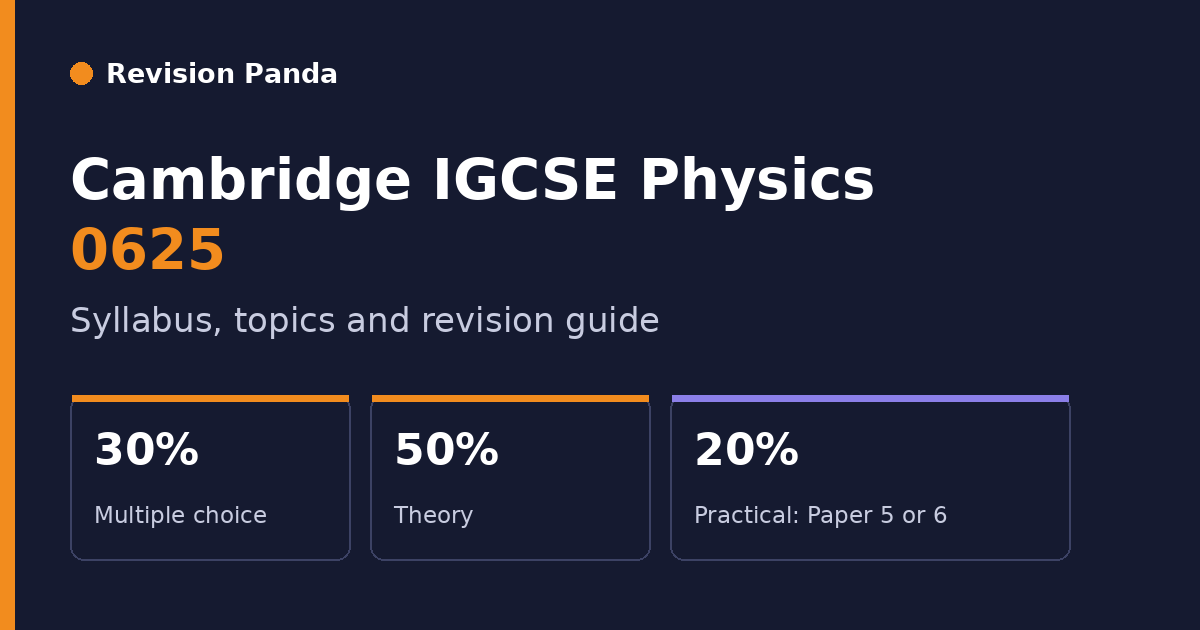
Cambridge IGCSE Physics (0625) is Cambridge’s full single-subject physics qualification for ages 14 to 16. This guide covers the current syllabus for exams in 2026, 2027 and 2028: the papers you sit, how Core and Extended differ, the practical paper options, the six topic areas, the equations and command words to know, and a revision plan that matches how the exam is marked.
- 0625syllabus code, graded A* to G
- 3papers per student, including one practical paper
- 6topic areas, from forces to space
- 20%of the grade comes from practical skills
What is Cambridge IGCSE Physics 0625?
0625 is a single-science IGCSE: it gives one grade in physics alone, rather than combining physics with biology and chemistry. Exams run in the June and November series, with an extra March series for schools in India.
The syllabus described here is for exams in 2026, 2027 and 2028. Cambridge’s latest version of it, published in December 2025, notes no significant changes that affect teaching. Cambridge has also published a syllabus for 2029 exams, again with no significant changes affecting teaching and the same paper structure, so the advice on this page carries forward.
Schools that want students to study all three sciences in less timetable time sometimes choose Cambridge IGCSE Combined Science (0653) or Co-ordinated Sciences (0654) instead. Those cover less physics in less depth. If you plan to take physics at AS & A Level, 0625 is the more direct preparation. For how IGCSE fits into the wider Cambridge pathway, see our Cambridge IGCSE guide.
Paper structure: what you actually sit
Every 0625 student sits three papers: a multiple-choice paper, a theory paper and a practical-skills paper. The first two depend on whether you are entered for Core or Extended. The practical paper is either Paper 5 or Paper 6, whichever your school chooses.
| Paper | Tier | Type | Time | Marks | Weighting |
|---|---|---|---|---|---|
| Paper 1 | Core | Multiple choice: 40 four-option questions | 45 min | 40 | 30% |
| Paper 2 | Extended | Multiple choice: 40 four-option questions | 45 min | 40 | 30% |
| Paper 3 | Core | Theory: short-answer and structured questions | 1 h 15 min | 80 | 50% |
| Paper 4 | Extended | Theory: short-answer and structured questions | 1 h 15 min | 80 | 50% |
| Paper 5 | Both | Practical test in a laboratory | 1 h 15 min | 40 | 20% |
| Paper 6 | Both | Alternative to practical (written) | 1 h | 40 | 20% |
Core route
- Paper 1 (multiple choice) + Paper 3 (theory)
- Plus Paper 5 or Paper 6
- Grades available: C to G
- Covers the Core content only
Extended route
- Paper 2 (multiple choice) + Paper 4 (theory)
- Plus Paper 5 or Paper 6
- Grades available: A* to G
- Covers the Core content plus the Supplement content
Different from IGCSE maths: in 0625 the Extended route can award the full range of grades, A* to G. That makes Extended a lower-risk choice in physics than in Cambridge IGCSE Mathematics 0580, where Extended grades stop at E.
Calculators may be used in every part of the exam. Trigonometric functions are only needed by Extended candidates.
What the papers are testing
Cambridge assesses three skills, called assessment objectives. Knowing the balance tells you where marks come from.
| Assessment objective | What it means | Share of the qualification | Where it is tested |
|---|---|---|---|
| AO1 | Knowledge with understanding: facts, definitions, laws, units and equations | 50% | 63% of Papers 1 to 4 |
| AO2 | Handling information and solving problems: calculations, graphs, unfamiliar situations | 30% | 37% of Papers 1 to 4 |
| AO3 | Experimental skills and investigations | 20% | All of Paper 5 or Paper 6 |
Half the qualification is knowledge you can learn directly. Nearly a third is problem solving, which only improves with practice on exam-style questions. A fifth is practical skills, which many students under-revise.
Paper 5 or Paper 6: the practical options
Both papers assess the same practical skills and are worth the same 20%. The difference is whether you carry out experiments in the exam.
Paper 5: Practical Test
- 1 hour 15 minutes, 40 marks
- You carry out experiments in a laboratory under exam conditions
- You take real readings, record them, plot graphs and draw conclusions
- Needs the school to run supervised practical sessions
Paper 6: Alternative to Practical
- 1 hour, 40 marks
- A written paper: no experiments in the exam room
- Tests the same experimental skills using described or pictured experiments
- Common for private candidates and schools without exam lab facilities
The skills tested are the same either way: choosing and using apparatus safely, planning an investigation, recording observations and readings, interpreting and evaluating data, and evaluating methods. Students taking Paper 6 still need hands-on practical experience during the course, because questions assume you know how real equipment behaves. Our IGCSE science practical skills guide covers both papers in detail, including how to draw tables and graphs the way examiners expect.
The 0625 topic map
The syllabus is organised into six topic areas. Extended (Supplement) content sits inside each sub-topic rather than in separate sections, so Extended students go further within the same headings.
| Topic | Sub-topics | Typical Extended extras (examples) |
|---|---|---|
| 1. Motion, forces and energy | Physical quantities and measurement; motion; mass and weight; density; forces; momentum; energy, work and power; pressure | Vectors and resultants, F = ma, momentum and impulse, efficiency, pressure in liquids |
| 2. Thermal physics | Kinetic particle model of matter; thermal properties and temperature; transfer of thermal energy | Gas pressure and volume calculations, specific heat capacity |
| 3. Waves | General properties of waves; light; electromagnetic spectrum; sound | Refractive index and critical angle, diffraction detail, ultrasound uses |
| 4. Electricity and magnetism | Simple phenomena of magnetism; electrical quantities; electric circuits; electrical safety; electromagnetic effects | Resistance and wire dimensions, potential dividers, transformers and power transmission |
| 5. Nuclear physics | The nuclear model of the atom; radioactivity | Decay equations, half-life calculations allowing for background radiation |
| 6. Space physics | The Earth and the Solar System; stars and the Universe | Orbital speed calculations, the Hubble constant and estimating the age of the Universe |
The third column gives examples to show the kind of extra depth, not a complete list. The official syllabus marks every Supplement learning outcome individually, so use it as your checklist and tick each outcome off once you can answer exam questions on it.
Easy to underestimate: space physics (topic 6) is the newest part of the syllabus and has fewer older past-paper questions to practise from. Make sure you have worked through it using the current specimen and recent papers.
Equations, units and symbols
The syllabus asks students to ‘recall and use’ a set of equations. In practice, plan to learn every equation listed for your tier, and practise rearranging each one, because questions often ask for the quantity that is not the subject of the equation.
Motion and forces
Speed = distance ÷ time; acceleration = change in velocity ÷ time; weight = mass × gravitational field strength; density = mass ÷ volume.
Energy and pressure
Kinetic energy = ½mv²; change in gravitational potential energy = mgΔh; work done = force × distance; power = work done ÷ time; pressure = force ÷ area.
Electricity and waves
Charge = current × time; voltage = current × resistance; power = current × voltage; wave speed = frequency × wavelength.
These are examples, not the complete list, and some equations are Extended only. Our IGCSE and GCSE physics equations guide lists every equation with its units and a worked example.
Units and prefixes
The syllabus lists the symbols and units you are expected to use. Extended candidates also need the prefixes G (giga), µ (micro) and n (nano), alongside the more common k, M and m. Many lost marks in physics are unit errors: converting cm to m, g to kg, or minutes to seconds before using an equation. Always write the unit with your final answer.
How much maths does physics need?
IGCSE physics uses mostly straightforward maths, but it uses it constantly. You need to rearrange equations, work with standard form and unit prefixes, calculate the gradient of a graph and read values from a graph accurately. Extended students also use trigonometry, for example in refraction and critical-angle questions. If rearranging equations feels shaky, fix that early: almost every topic depends on it, and it is the skill A Level physics builds on most heavily.
Command words: what the question wants
Every 0625 question uses a command word that tells you what kind of answer earns the marks. These are the command words listed in the syllabus, with a plain-English guide to each.
| Command word | What to do |
|---|---|
| State / Give | A short answer: a fact, value or name, with no explanation needed |
| Define | Give the precise meaning of a term, ideally in the standard wording |
| Identify | Pick out or name something from information given |
| Describe | Say what happens or what something is like, in steps or with features; no ‘why’ needed |
| Explain | Give reasons: say why or how, linking cause and effect with physics ideas |
| Calculate | Work out a numerical answer, showing working and giving the unit |
| Determine | Find a value, often from data or a graph, rather than by recall |
| Deduce | Reach a conclusion from the information provided |
| Predict | Say what will happen, based on data or physics ideas |
| Suggest | Apply knowledge to an unfamiliar situation; more than one answer may be accepted |
| Compare | Give similarities and/or differences, mentioning both things in each point |
| Comment | Give an informed opinion on data or a statement |
| Justify | Support a choice or conclusion with evidence or reasons |
| Sketch | Draw the general shape of a graph or diagram, with key features labelled; precise plotting not required |
The most common confusion is between describe and explain. ‘Describe the motion’ wants what happens (it speeds up, then moves at constant speed). ‘Explain the motion’ wants why (the resultant force is zero, so the speed stays constant).
How to revise for 0625
Physics needs three kinds of revision at once: knowledge, calculations and practical skills. This six-step approach covers all three.
Audit the topic map
Rate every syllabus outcome for your tier red, amber or green. Green means you can answer an exam question on it without notes.
Learn definitions and equations actively
Use flashcards for definitions, units and equations, and test yourself from memory rather than re-reading. Five minutes a day beats an hour once a week.
Drill multiple choice
Papers 1 and 2 give you about a minute per question. Practise topic-based multiple-choice sets, then full papers against the clock. For every wrong answer, work out why each wrong option is wrong.
Practise structured questions
For the theory papers, do past-paper questions topic by topic, then full papers. Mark them with the official mark scheme and note exactly which points earned marks.
Revise practical skills separately
Practise drawing results tables, choosing graph scales, drawing lines of best fit, finding gradients and evaluating experiments. These skills earn 20% of the grade on their own.
Keep an error log
Record every mistake with its topic and cause: knowledge, unit, rearranging, misreading or command word. Revise from the log in the final weeks.
Use official Cambridge past papers, mark schemes and examiner reports from your school or Cambridge. Our guide to using IGCSE past papers explains how to get the most from them.
Pacing yourself in the exam
| Paper | Time | Marks | Roughly |
|---|---|---|---|
| Paper 1 or 2 (multiple choice) | 45 minutes | 40 | About 1 minute per question |
| Paper 3 or 4 (theory) | 75 minutes | 80 | Just under 1 minute per mark |
| Paper 5 (practical test) | 75 minutes | 40 | Nearly 2 minutes per mark, with time for setting up and taking readings |
| Paper 6 (alternative to practical) | 60 minutes | 40 | 1½ minutes per mark |
The theory papers are the tightest. If a calculation stalls, write down the equation and substitute what you know: that often earns a method mark. Then move on and come back to it.
Common mistakes in IGCSE physics
Missing or wrong units
Forgetting the unit, or using cm, g or minutes in an equation that needs m, kg or s, is one of the most frequent ways to lose easy marks.
Describing instead of explaining
An ‘explain’ question needs a reason linked to physics. Restating what happens earns little.
Vague wording
Physics terms are precise. Write ‘thermal energy’ or ‘internal energy’ rather than ‘heat energy’, and ‘resultant force’ rather than just ‘force’ when that is what you mean.
Weak graph skills
Graphs need labelled axes with units, a sensible scale that uses most of the grid, accurately plotted points and a single smooth line or curve of best fit.
No working in calculations
Write the equation, substitute the values, then give the answer with its unit. Method marks are lost when only a final number appears.
Ignoring significant figures
Give answers to a sensible number of significant figures, usually matching the data given, and do not round in the middle of a calculation.
Series, grades and what comes next
0625 exams run in June, with results in August, and in November, with results in January; schools in India can also use the March series. Grades run from A* to G, with U for ungraded. The marks needed for each grade are set after every series and published by Cambridge as grade threshold tables.
A good Extended grade in 0625 is the usual preparation for Cambridge International AS & A Level Physics (9702). Students going on to A Level should make sure they are confident with the Extended mathematical content, especially rearranging equations, gradients and graphs. Our AS & A Level guide explains how the next stage works.
Questions to ask your physics teacher
- Am I entered for Core or Extended, and when is the final decision made?
- Will I take Paper 5 (practical test) or Paper 6 (alternative to practical)?
- Which syllabus year am I following, and which past papers match it?
- Which equations do I need to recall, and which will I see in questions?
- What were my weakest topics and skills in my last mock?
- Can I have the official mark schemes and examiner reports for practice papers?
- What grade do I need to take physics at AS & A Level?
The short version
Cambridge IGCSE Physics 0625 is assessed by three papers: multiple choice (30%), theory (50%) and practical skills (20%). Core students sit Papers 1 and 3 for grades C to G; Extended students sit Papers 2 and 4 and can achieve A* to G. Everyone also takes either Paper 5 (a lab-based practical test) or Paper 6 (a written alternative). The syllabus covers six topic areas. Learn the equations and units, practise command words and graphs, and revise practical skills as seriously as theory.
Choose your curriculumSources and method. Papers, durations, marks, weightings, routes, grades available, assessment objectives, topics, command words, calculator rules and practical paper descriptions: Cambridge IGCSE Physics 0625 syllabus for 2026, 2027 and 2028 (Cambridge International, version 2, December 2025). 2029 continuity: Cambridge IGCSE Physics 0625 syllabus for 2029. Combined and Co-ordinated Sciences codes: Cambridge International. Command-word explanations, Extended examples, revision steps, pacing and common mistakes are Revision Panda’s editorial guidance. We do not reproduce past papers or mark schemes; use the official versions. Last checked November 2026.