Cambridge IGCSE Mathematics (0580): Syllabus, Topics and Revision Guide
Cambridge IGCSE Mathematics 0580 is assessed by two equally weighted exams, one non-calculator and one calculator. Core students sit Papers 1 and 3 (1h30, 80 marks each, grades C to G). Extended students sit Papers 2 and 4 (2h, 100 marks each, grades A* to E).
0580 is Cambridge International's standard IGCSE maths syllabus for ages 14 to 16, graded A* to G, covering nine topic areas from Number to Statistics.
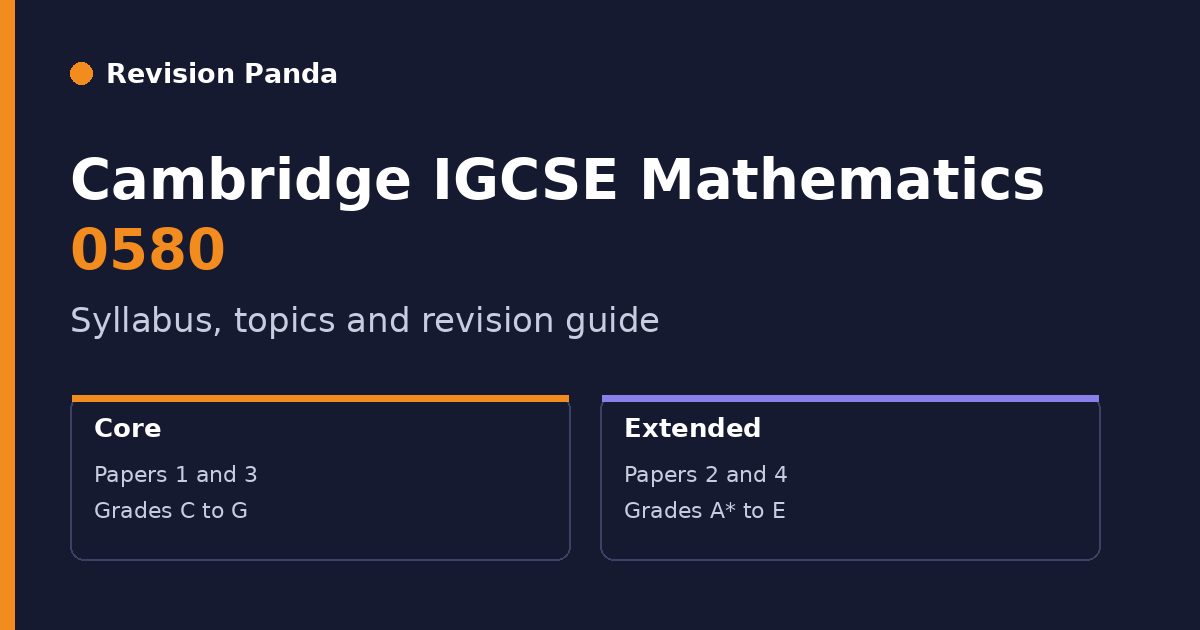
Cambridge IGCSE Mathematics (0580) is the standard Cambridge maths qualification for ages 14 to 16. This guide covers everything on the current syllabus for exams in 2025, 2026 and 2027: which papers you sit, how Core and Extended differ, the full topic map, the rules on calculators and accuracy, and a revision approach built around the way the exam is actually marked.
- 0580syllabus code (graded A* to G)
- 2papers per student, each worth 50%
- 9topic areas, from Number to Statistics
- 1 of 2papers is non-calculator
What is Cambridge IGCSE Mathematics 0580?
0580 is the most widely used of Cambridge’s IGCSE maths syllabuses. It is assessed entirely by written exams, with no coursework, and it is offered in the June and November series, plus a March series in India only.
Cambridge runs more than one maths syllabus at this level, and schools pick one. They cannot be combined: a student cannot be entered for 0580 in the same series as Cambridge IGCSE (9–1) Mathematics 0980, Cambridge IGCSE International Mathematics 0607 or Cambridge O Level Mathematics 4024.
| Syllabus | Code | How it is graded | Who usually takes it |
|---|---|---|---|
| Cambridge IGCSE Mathematics | 0580 | A* to G | Most Cambridge schools worldwide |
| Cambridge IGCSE (9–1) Mathematics | 0980 | 9 to 1 | Schools, often in the UK, that want grades on the same scale as GCSE |
| Cambridge IGCSE International Mathematics | 0607 | A* to G | Schools wanting a different emphasis; it has its own content and papers |
Most schools teach 0580 as a two-year course, usually starting at around age 14, though some start earlier or teach it faster. Private candidates can enter through a Cambridge exam centre, and students can retake the whole qualification in a later series if they want a higher grade. You cannot retake a single paper on its own.
If you are not sure which one you are taking, the syllabus code is printed on every exam timetable and statement of entry. Revision guides and past papers must match that code. For how IGCSE fits into the wider Cambridge qualifications, see our Cambridge IGCSE guide.
Paper structure: what you actually sit
Every 0580 student sits exactly two papers: one without a calculator and one with. Which pair depends on whether you are entered for Core or Extended. You cannot mix papers from the two tiers.
Core: Papers 1 and 3
- Paper 1, non-calculator: 1 hour 30 minutes, 80 marks, 50%
- Paper 3, calculator: 1 hour 30 minutes, 80 marks, 50%
- Grades available: C to G
- Covers the Core content only
Extended: Papers 2 and 4
- Paper 2, non-calculator: 2 hours, 100 marks, 50%
- Paper 4, calculator: 2 hours, 100 marks, 50%
- Grades available: A* to E
- Covers the Core content plus the Extended content
Students answer all the questions on every paper; there is no choice of questions. Since 2025, each paper has a formula sheet at the front, with a slightly longer list on the Extended papers. You will need compasses, a protractor and a ruler for both papers.
What the papers are testing
Cambridge assesses two skills, called assessment objectives. The balance differs by tier, and it explains why Extended papers feel so different from Core ones.
| Assessment objective | What it means | Core | Extended |
|---|---|---|---|
| AO1 | Knowing and using mathematical techniques | 60–70% | 40–50% |
| AO2 | Analysing, interpreting and communicating mathematically, including problem solving | 30–40% | 50–60% |
In plain terms: more than half of an Extended paper rewards reasoning and problem solving, not just carrying out a method you have practised. That is why students who know every technique can still lose marks on unfamiliar question styles, and why past-paper practice matters so much.
Core or Extended: which is right?
Your school makes the entry decision, usually in the final year once mock results are in. The grade cap is the deciding factor: a Core candidate cannot score above a C, however well they do.
Choose Extended if…
You are aiming for a B or above, or you may study maths at AS & A Level. Cambridge recommends Extended as preparation for AS & A Level Mathematics (9709).
Choose Core if…
A secure C is the realistic target and Extended content is causing real difficulty. Core papers are shorter and focus more on standard techniques.
The risk at the boundary
Extended papers award grades down to E. A student who falls below that receives a U (ungraded), so borderline students and teachers weigh the higher ceiling against that risk.
If a sixth form or university course asks for a particular IGCSE maths grade, check it before tier decisions are made. Some sixth forms expect at least a B or an A in Extended maths before they accept a student onto A Level Mathematics.
The 0580 topic map
The syllabus is organised into nine topic areas. Every Extended student learns all the Core content too, so the third column shows only what Extended adds. Use this as a checklist: tick off each sub-topic once you can answer exam questions on it, not just when you have read about it.
| Topic | Core content | Extended adds |
|---|---|---|
| 1. Number | Types of number, sets, powers and roots, fractions, decimals and percentages, ordering, the four operations, indices, standard form, estimation, limits of accuracy, ratio and proportion, rates, percentages, using a calculator, time, money | Exponential growth and decay; surds |
| 2. Algebra and graphs | Introduction to algebra, algebraic manipulation, indices, equations, inequalities, sequences, graphs in practical situations, graphs of functions, sketching curves | Algebraic fractions; proportion; differentiation; functions |
| 3. Coordinate geometry | Coordinates, drawing linear graphs, gradient, equations of linear graphs, parallel lines | Length and midpoint; perpendicular lines |
| 4. Geometry | Geometrical terms, constructions, scale drawings, similarity, symmetry, angles, circle theorems | Circle theorems in more depth, with further detail across the topic |
| 5. Mensuration | Units of measure, area and perimeter, circles, arcs and sectors, surface area and volume, compound shapes and parts of shapes | Same headings, with more demanding questions |
| 6. Trigonometry | Pythagoras’ theorem; right-angled triangles | Exact trigonometric values; trigonometric functions; non-right-angled triangles; Pythagoras and trigonometry in 3D |
| 7. Transformations and vectors | Transformations | Vectors in two dimensions; magnitude of a vector; vector geometry |
| 8. Probability | Introduction to probability, relative and expected frequencies, combined events | Conditional probability |
| 9. Statistics | Classifying and interpreting data, averages and range, charts and diagrams, scatter diagrams | Measures of spread; cumulative frequency diagrams; histograms |
Where Extended students lose most time: the Extended-only content (functions, differentiation, vectors, non-right-angled trigonometry, histograms and conditional probability) is often taught last. Start revising these early rather than leaving them until the final weeks.
The full list of learning outcomes, with examples for every sub-topic, is in the official syllabus document. It is worth printing the pages for your tier: the ‘notes and examples’ column shows exactly how far each topic goes.
Formulas: what is given and what you must know
Since the 2025 syllabus, a formula sheet appears at the front of every 0580 paper. It does not include everything. Some formulas must still be learned, and knowing a formula is not the same as recognising when a question needs it.
On the sheet
Mostly area and volume formulas for the harder shapes. The Extended sheet also gives the quadratic formula, the sine and cosine rules and the area of a triangle using ½ab sin C.
Not on the sheet
Anything not printed on the sheet for your tier must be recalled, including everyday results such as Pythagoras’ theorem and the basic trigonometric ratios. The sheet is the same in every series, so print it from the syllabus and learn what is missing from it.
Our IGCSE maths formulas guide lists every formula you need, sorted into those given on the paper and those to memorise, with a worked example of each.
Calculator, accuracy and working: the rules that cost marks
These rules come straight from the syllabus. They are simple, but every series some students lose marks by ignoring them.
- Accuracy: unless the question says otherwise, give non-exact answers to 3 significant figures, and angles in degrees to 1 decimal place.
- Do not round early: keep full values on your calculator until the final answer, and reuse the unrounded value in later parts.
- Pi: use the π key on your calculator or the value 3.142.
- Calculators: a scientific calculator is required for Papers 3 and 4. Graphical and algebraic calculators are not allowed.
- Show your working: students must show all necessary working. A correct method can earn marks even when the final answer is wrong; a bare wrong answer earns nothing.
- Non-calculator papers: Papers 1 and 2 test written methods for fractions, decimals, percentages, standard form and surds. Practise them without a calculator from the start of the course.
How to revise for 0580
The most effective revision mirrors the exam: mixed questions, no calculator for half of it, and marking against the real mark scheme. This six-step approach works for both tiers.
Audit the topic map
Go through the nine topics above and rate each sub-topic red, amber or green. Be honest: green means you can do an exam question on it unaided.
Fix the red topics first
Use your textbook or class notes to relearn one red topic at a time, then do a short set of past-paper questions on that topic only.
Build non-calculator fluency
Spend ten minutes a day on written arithmetic: fractions, percentages, standard form, negative numbers and, for Extended, surds. Speed here buys time for problem-solving questions.
Move to full past papers
Once most topics are amber or green, sit complete papers under timed conditions, alternating the non-calculator and calculator papers for your tier.
Mark with the official mark scheme
Mark every paper yourself using the published mark scheme, and note where method marks were available. Our guide to using IGCSE past papers explains how.
Keep an error log
Write down every mistake, the topic and the reason (method, misreading, arithmetic, accuracy). Revise from the log in the final weeks: it shows exactly where your marks are going.
Pacing yourself in the exam
Both tiers give you a little over a minute per mark. Knowing the figure for your paper helps you spot when a question is eating too much time.
| Paper | Time | Marks | Time per mark | A 4-mark question should take about |
|---|---|---|---|---|
| Paper 1 or 3 (Core) | 90 minutes | 80 | About 1 minute 7 seconds | 4 to 5 minutes |
| Paper 2 or 4 (Extended) | 120 minutes | 100 | About 1 minute 12 seconds | 5 minutes |
A practical approach: work through the paper in order, but if a question has taken twice its ‘fair’ time with no progress, mark it, move on and come back at the end. Aim to finish with ten minutes to spare for checking. Use that time to re-read each question, not to redo the arithmetic. Most lost marks come from answering a slightly different question from the one asked, such as giving an area when a perimeter was asked for, or the wrong units or accuracy.
On the non-calculator paper, write down the calculation before doing it and show each line of working. Examiners can award method marks for a clear method even when the arithmetic slips. On the calculator paper, write down the full calculator display before rounding, so both the method and the accuracy are visible.
Past papers, mark schemes and examiner reports for 0580 are published by Cambridge for schools, and many schools share them with students. Always use the official versions; never use papers that claim to be from a series that has not yet been sat.
Common mistakes in IGCSE maths
These patterns come up again and again in marking. Each one is fixable with practice.
Rounding too early
Rounding an intermediate value and carrying it forward can push the final answer outside the accepted range. Keep the full value until the end.
Wrong accuracy
Giving 2 significant figures where 3 are needed, or rounding an angle to a whole number, can lose an accuracy mark on an otherwise correct answer.
No working shown
On multi-mark questions, method marks are only available if the method is on the page. Write every step, even when it feels obvious.
Calculator in the wrong mode
A calculator set to radians instead of degrees gives wrong trigonometry answers. Check the mode before the calculator paper starts.
Misreading the question
Watch for units (cm or m), what the question asks you to give (exact value, simplest form, nearest whole number) and command words such as ‘show that’, where the method is the answer.
Skipping the last parts
Later parts of a long question often do not depend on earlier answers. If you are stuck on part (b), still try part (c).
Exam series, grades and what comes next
0580 exams run in two main series each year. The June series has results in August, and the November series has results in January. Schools in India can also enter the March series. Grades run from A* to G, with U for ungraded, and the grade boundaries for each paper are set after every series.
After IGCSE, a strong Extended grade is the usual route into Cambridge International AS & A Level Mathematics (9709). Our AS & A Level guide explains how that qualification works and how AS and A Level relate.
The 0580 syllabus is updated in cycles. The version described on this page covers exams in 2025, 2026 and 2027. Cambridge has published a new version for exams from 2028, so students starting the course for exams in 2028 or later should check the latest syllabus on Cambridge’s website.
Questions to ask your maths teacher
- Am I being entered for 0580, 0980 or another syllabus, and in which series?
- Am I on track for Core or Extended, and when will the final decision be made?
- What grade do I need for the sixth form or A Level course I am considering?
- Which topics are still to be taught before the exam?
- Can I have the official past papers, mark schemes and examiner reports for my tier?
- Which calculator model do you recommend, and is mine allowed?
- What were my weakest topics in my last mock, and what should I do first?
The short version
Cambridge IGCSE Mathematics 0580 is assessed by two exams of equal weight, one without a calculator and one with. Core students sit Papers 1 and 3 for grades C to G; Extended students sit Papers 2 and 4 for grades A* to E. The syllabus covers nine topic areas, and more than half of the Extended marks reward reasoning and problem solving. Revise topic by topic, then move to timed past papers marked with the official mark scheme, and keep a log of every mistake.
Choose your curriculumSources and method. Paper structure, durations, marks, weightings, grades available, assessment objectives, topic list, accuracy and calculator rules, formula sheet, series and combination restrictions: Cambridge IGCSE Mathematics 0580 syllabus for 2025, 2026 and 2027 (Cambridge International). Formula sheet introduction and non-calculator Papers 1 and 2: Cambridge ‘Getting ready to teach’ factsheet for 0580. Progression to 9709 and the 2028–2030 syllabus: Cambridge International subject information. Revision steps and common mistakes are Revision Panda’s editorial guidance, not Cambridge requirements. We do not reproduce past papers or mark schemes; use the official versions from your school or Cambridge. Last checked November 2026.