GCSE and the UK Curriculum: A Guide for International Students
GCSEs are the qualifications most students in England take at 16, at the end of Key Stage 4 (Year 11). Each subject is a separate GCSE set by an exam board such as AQA, Pearson Edexcel or OCR and graded 9 to 1, where 4 is a standard pass and 5 a strong pass.
The UK curriculum usually means the national curriculum for England: a framework of Key Stages from age 5 to 16 that sets what pupils are taught, ending with GCSEs. Wales, Northern Ireland and Scotland run their own systems.
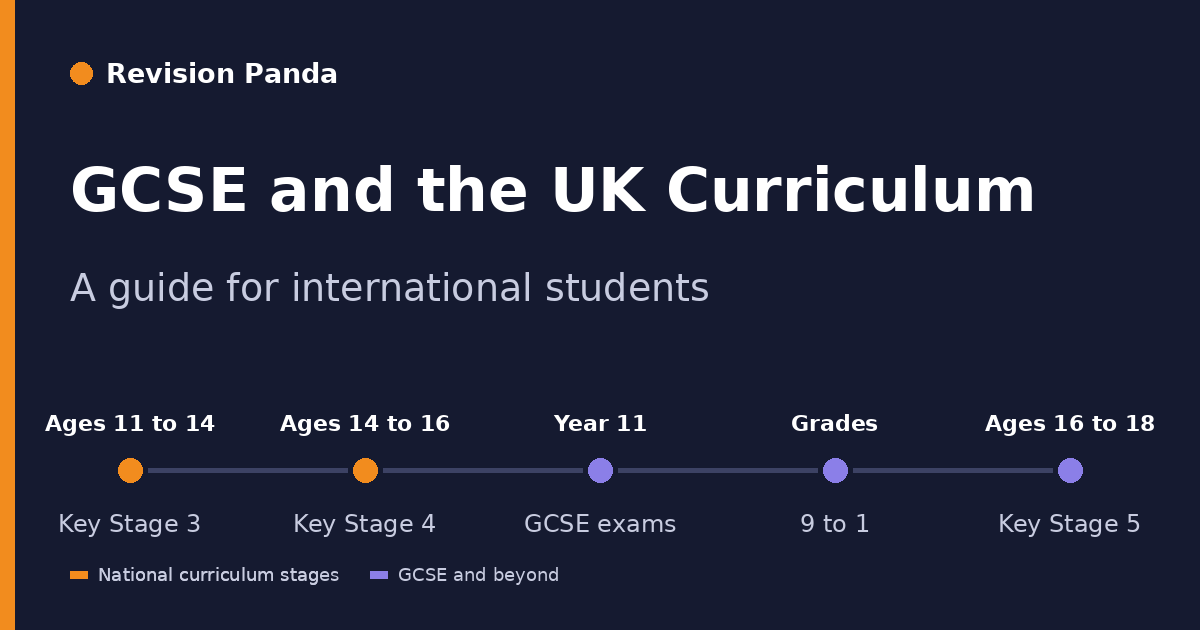
GCSEs are the exams most students in England take at 16. They sit inside the national curriculum, a framework of Key Stages that runs from age 5 to 16, and they are the qualification sixth forms, colleges and universities look at first. If your family is moving to the UK, studying at a British school abroad or weighing GCSE against Cambridge IGCSE, this guide explains how the system fits together, who sets the exams, how the 9 to 1 grades work and what changes for international students.
- 4Key Stages from age 5 to 16
- 9–1GCSE grading scale in England
- Grade 4the ‘standard pass’
- 19 AugGCSE results day 2027
First, the UK is not one school system
‘The UK curriculum’ usually means the national curriculum in England. Education is run separately in each of the four UK nations, so the rules, qualifications and even the grades differ depending on where a school is.
| Nation | Qualification at 16 | How it is graded | Main exam boards |
|---|---|---|---|
| England | GCSE | Numbers, 9 (highest) to 1, plus U | AQA, Pearson Edexcel, OCR, WJEC Eduqas |
| Wales | GCSE (Welsh versions) | Mostly letters, A* to G | WJEC |
| Northern Ireland | GCSE | Letters A* to G with an extra C* grade; some schools use English boards graded 9 to 1 | CCEA, plus English boards |
| Scotland | National 5 (not GCSE) | Its own system | Scotland’s own national body |
The rest of this guide focuses on England, because that is where most GCSEs are taken and where most British international schools take their curriculum from. When a school abroad calls itself ‘British curriculum’, it almost always means it follows the national curriculum for England up to age 14, then teaches GCSEs, Cambridge IGCSEs or another international GCSE for ages 14 to 16.
How school in England is organised: the Key Stages
The national curriculum is organised into blocks of school years called Key Stages. Each Key Stage sets out what pupils should be taught, and some end with national tests. After the Early Years (ages 3 to 5), it looks like this:
- Ages 5 to 7Key Stage 1Years 1 and 2. Phonics screening check in Year 1.
- Ages 7 to 11Key Stage 2Years 3 to 6. Times tables check in Year 4; national tests in Year 6.
- Ages 11 to 14Key Stage 3Years 7 to 9. The first years of secondary school; no national tests.
- Ages 14 to 16Key Stage 4Years 10 and 11. Most pupils take GCSEs at the end of Year 11.
- Ages 16 to 18Key Stage 5Years 12 and 13 (sixth form). A Levels, T Levels or other routes.
Year groups, ages and national assessments
School years in England run from September, and a child’s year group is set by their age on 1 September. This is the detail that most often catches out families arriving from abroad: a child is placed by birthday, not by the grade they finished at their previous school.
| Year group | Age during the year | Key Stage | National assessment |
|---|---|---|---|
| Reception | 4 to 5 | Early Years | Baseline check in the first six weeks; Early Years profile |
| Year 1 | 5 to 6 | KS1 | Phonics screening check |
| Year 2 | 6 to 7 | KS1 | Optional tests and teacher assessment |
| Year 4 | 8 to 9 | KS2 | Multiplication tables check |
| Year 6 | 10 to 11 | KS2 | National tests in reading, maths, and grammar, punctuation and spelling; teacher assessment in writing and science |
| Years 7 to 9 | 11 to 14 | KS3 | None nationally; schools assess internally |
| Year 10 | 14 to 15 | KS4 | Some pupils take GCSEs early |
| Year 11 | 15 to 16 | KS4 | Most pupils take GCSEs or other national qualifications |
Converting from the US system? As a rough guide, a UK year number is one higher than the US grade for the same age: Year 10 lines up with US Grade 9 and Year 11 with Grade 10. Always confirm placement with the school, because the birthday cut-off decides it.
What students study at 11 to 16
The national curriculum lists compulsory subjects for each Key Stage. It narrows as students get older, which is what makes room for GCSE choices.
Key Stage 3 (ages 11 to 14)
A broad programme. The compulsory subjects are:
- English, maths and science
- History and geography
- Modern foreign languages
- Design and technology, art and design, music
- Physical education, citizenship and computing
Key Stage 4 (ages 14 to 16)
A smaller compulsory core, plus choices:
- Core: English, maths and science
- Foundation: computing, physical education and citizenship
- Entitlement: schools must offer at least one subject in each of the arts, design and technology, the humanities and modern foreign languages
Alongside these, schools must also teach relationships, sex and health education and religious education. Parents can choose to withdraw their child from sex education and religious education.
Not every school is bound by the national curriculum in full. Academies and private (independent) schools in England do not have to follow it, although academies must still teach a broad and balanced curriculum that includes English, maths and science. In practice most secondary schools teach something close to it, because GCSE content is set nationally and every school is preparing students for the same exams.
You may also see the English Baccalaureate (EBacc) mentioned. It is not a qualification: it is a government measure of how many students take GCSEs in English, maths, the sciences, history or geography, and a language. It has shaped which subjects many schools encourage, but a recent national review recommended removing it (see ‘What is changing’ below).
How GCSEs are structured
GCSE stands for General Certificate of Secondary Education. Each GCSE is a separate qualification in one subject, so a student finishes Year 11 with a set of individual grades rather than one overall diploma. Most students study GCSEs over two years, Years 10 and 11, and take nearly all their exams in May and June at the end of Year 11.
How many subjects
Schools commonly enter students for around 8 to 10 GCSEs. There is no fixed national number; it depends on the school and the student.
Compulsory and options
English language, English literature (in most schools), maths and science are usually taken by everyone. Students then choose ‘options’, typically in Year 9.
Mainly exams
Reformed GCSEs in England are assessed mostly by exams at the end of the course. Some subjects, such as art, design and technology or computing, include non-exam assessment.
Combined science or triple science
Science is the subject where routes differ most. Combined science covers biology, chemistry and physics in one course worth two GCSEs, and gives a double grade such as 6-6 or 7-6. Triple science (sometimes called separate sciences) means three full GCSEs in biology, chemistry and physics, each with its own grade. Both can lead to science A Levels, but some sixth forms prefer triple science for students who want to take two or more sciences further. Ask your school what it requires.
Foundation and Higher tiers
Some GCSEs are ‘tiered’: students sit either a Foundation paper or a Higher paper. The tiered subjects are maths, statistics, combined science, biology, chemistry, physics and modern foreign languages. The tier decides which grades are available.
Foundation tier
- Grades 5 to 1 available (5-5 to 1-1 in combined science)
- The highest possible grade is 5, a strong pass
- Questions are less demanding
- Suits students aiming securely for a 4 or 5
Higher tier
- Grades 9 to 4 available, with a narrow ‘safety net’ grade 3
- Students who fall below that receive a U (ungraded)
- Needed for grades 6 to 9
- Often expected for A Level maths or sciences
The tiers overlap at grades 4 and 5, and the exam boards are required to make a 4 or 5 no easier or harder to achieve on either tier. The certificate shows only the subject and grade, not the tier. The school, not the student, makes the final entry decision, usually during Year 11.
Who sets the exams: UK exam boards
GCSEs are not written by the government. They are written, marked and graded by exam boards (officially ‘awarding bodies’), and each board publishes its own specification for each subject. The government sets the subject content that every board must cover, and an independent regulator checks the standard.
| Exam board | Where it is mainly used | Good to know |
|---|---|---|
| AQA | England | A large GCSE board in English schools. It does not allow private candidates to sit its GCSEs outside the UK. |
| Pearson Edexcel | England and internationally | Offers UK GCSEs and a separate International GCSE for schools abroad. |
| OCR | England | Part of Cambridge University Press & Assessment, like Cambridge International, but it sets UK GCSEs, not IGCSEs. |
| WJEC Eduqas | England | The English-market brand of the Welsh board WJEC. |
| WJEC | Wales | Sets the GCSEs taught in Welsh schools, mostly graded A* to G. |
| CCEA | Northern Ireland | Northern Ireland’s own board and regulator. |
In England the regulator is Ofqual. The boards work together through the Joint Council for Qualifications (JCQ), which sets one shared exam timetable and the national results days. A school can use different boards for different subjects, so one student might take AQA English, Edexcel maths and OCR history. It rarely matters to universities which board a GCSE came from, but it matters a lot when revising: past papers, mark schemes and the order of topics are board-specific, so always check the board and specification code before you buy a revision guide.
The 9 to 1 grading scale
GCSEs in England are graded from 9 (highest) to 1 (lowest). A result below grade 1 is a U, meaning ungraded, and it does not count as a GCSE. The numbers replaced the old A* to G letters, and the extra grades at the top were added to separate the highest-performing students more clearly.
- 9Highest
- 8Top
- 7Old A
- 6Old B
- 5Strong pass
- 4Standard pass
- 3Below pass
- 2Low
- 1Lowest
The scale was anchored to the old letters at three points: the bottom of grade 7 lines up with the bottom of the old A, the bottom of grade 4 with the bottom of the old C, and the bottom of grade 1 with the bottom of the old G. Grades in between are not exact one-to-one matches.
Grade 4: the standard pass
The Department for Education treats a 4 as a pass. It is the level most sixth forms, colleges and employers ask for in English and maths, and the level that decides whether a student must keep studying those subjects after 16.
Grade 5: the strong pass
Schools are also measured on the share of students achieving a 5 or above. Many sixth forms ask for a 5, 6 or higher in the subjects a student wants to take at A Level.
Grade boundaries, the marks needed for each grade, are set after every exam series and change from year to year so that a grade represents a consistent standard even when a paper turns out harder or easier. Our GCSE grades guide explains the scale, grade boundaries and the old-to-new comparison in more detail.
The GCSE years, step by step
School timetables vary, but most students in England follow a pattern like this. Dates shown are for students finishing Year 11 in summer 2027.
Year 9: choosing options
Most schools ask students to choose their GCSE options during Year 9, usually in the spring term. This is the decision point for languages, humanities, creative subjects and the science route.
Year 10: starting the courses
Two-year GCSE courses begin in September. Any non-exam assessment usually starts in Year 10 or early Year 11.
Year 11: mocks and tier decisions
Most schools run mock exams during Year 11. Results help teachers decide tiers of entry and help students plan revision.
May to June: the exam series
For 2027, the national timetable runs from 10 May to 22 June, covering GCSE, AS and A Level exams. Each board publishes its own subject-by-subject timetable within that window.
August: results day
GCSE results for the June 2027 series are released to students on Thursday 19 August 2027, one week after A Level results on 12 August.
November: resits in English and maths
A November series is available for GCSE English language and maths only, mainly for students resitting after 16. Results for the November 2026 series are due on 13 January 2027.
After GCSEs: ages 16 to 18
Students in England can leave school at the end of Year 11, but they must stay in education or training until their 18th birthday. That means one of three things: full-time education, such as sixth form or college; an apprenticeship; or working or volunteering for 20 hours or more a week alongside part-time education or training.
A Levels
The academic route to university, usually three subjects over two years in Years 12 and 13. GCSE grades decide which A Levels a student can take. Our AS & A Level guide explains how they work.
T Levels and other courses
Technical qualifications that combine classroom learning with an industry placement, plus a range of other vocational courses.
The English and maths rule
Students in England who do not reach at least a grade 4 in GCSE English or maths usually have to keep studying that subject after 16, often resitting it, until they pass or turn 18.
GCSE and Cambridge IGCSE: how they differ
Cambridge IGCSE is the international qualification at the same level. The two are often treated as equivalent for sixth form and university entry, but they are built for different settings. This summary covers the main points; our IGCSE vs GCSE comparison goes subject by subject.
| GCSE (England) | Cambridge IGCSE | |
|---|---|---|
| Designed for | Schools in England, following national subject content | Schools worldwide, with international content and contexts |
| Grading | 9 to 1 | A* to G in most syllabuses; 9 to 1 in some |
| Difficulty routes | Foundation and Higher tiers in some subjects | Core and Extended papers in many subjects |
| Exam series | May to June; November for English language and maths only | June and November, with results in August and January |
| Assessment | Mainly final exams; non-exam assessment in some subjects | Mainly exams; some syllabuses offer coursework or alternative-to-practical papers |
| Taking it abroad | Usually only through an approved school; private candidates generally sit in the UK | Widely available at approved centres, including for private candidates |
Pearson Edexcel and OxfordAQA also offer their own International GCSEs. These are separate qualifications from UK GCSEs, with their own specifications. For the full picture of Cambridge qualifications from age 5 to 19, see our Cambridge Pathway guide and our Cambridge IGCSE guide.
Can international students take GCSEs?
Yes, but the route depends on where the student lives and whether they are enrolled at a school. These are the four situations we see most often.
Moving to England
A student who joins an English school in Year 10 or 11 is entered for GCSEs by that school like any other pupil. Arriving part-way through Key Stage 4 can mean limited option choices, so ask early which courses still have space and which board each subject uses.
At a British school abroad
Some British international schools teach UK GCSEs, but many teach Cambridge IGCSE or another International GCSE instead. A student can generally only sit UK GCSE exams overseas if they are enrolled at an approved international school.
Home-educated outside the UK
Private candidates for UK GCSEs generally have to sit their exams in the UK, and AQA does not allow overseas private candidates at all. Cambridge IGCSE or an International GCSE is usually the practical route, because they can be sat at approved centres abroad.
Returning to the UK
Students returning with Cambridge IGCSE grades can normally use them for sixth form entry, but entry requirements are set by each sixth form or college. Ask how they treat IGCSE grades, particularly the A* to G scale, before you apply.
Inside the UK, private candidates, including home-educated students, can enter for GCSEs at exam centres that accept external candidates. JCQ publishes a list of these centres. Subjects with non-exam assessment, practical work or spoken components can be harder to arrange, so check with the centre before choosing subjects.
What is changing
England’s Curriculum and Assessment Review published its final report in November 2025, together with the government’s response. The changes affect the national curriculum and GCSEs in England, not Cambridge IGCSE or other international qualifications.
- A revised national curriculum is due to be published in 2027 for first teaching from September 2028.
- The government plans to cut the time students spend in GCSE exams by around 2.5 to 3 hours on average. The review itself had recommended a cut of at least 10%.
- Revised GCSEs are expected to arrive in phases, with first teaching from 2029 and 2030.
- The review recommended removing the EBacc measure and making triple science available to all students who want it.
Students starting GCSEs before the revised courses arrive will take the current specifications. We will update this page as Ofqual and the exam boards confirm the details.
Questions to ask your school
- Which exam board and specification code do you use for each GCSE subject?
- Do you offer combined science, triple science or both, and how do you decide who takes which?
- Which subjects are tiered, and when will you confirm my child’s tier of entry?
- When do students choose GCSE options, and which subjects are compulsory?
- Which subjects include non-exam assessment, and when is it completed?
- When are mock exams, and how are the results used?
- Does my child have the right year group for their age, given the 1 September cut-off?
- What GCSE grades do you or local sixth forms ask for to study each A Level?
The short version
England’s national curriculum runs in Key Stages from age 5 to 16, and GCSEs are taken at the end of Key Stage 4, in Year 11. Each GCSE is a separate qualification set by a board such as AQA, Pearson Edexcel or OCR and graded 9 to 1, where 4 is a standard pass and 5 a strong pass. Wales, Northern Ireland and Scotland run different systems. For students outside the UK, Cambridge IGCSE is usually easier to access and is widely treated as being at the same level.
Choose your curriculumSources and method. Key Stages, year groups, national assessments and compulsory subjects: GOV.UK, ‘The national curriculum’ and ‘Key stage 3 and 4’. Tiers and available grades: Ofqual guidance for schools and colleges and DfE statistics on November GCSE entries. Exam dates and results days: JCQ key dates for the June 2027 series, GOV.UK exam season guidance and AQA results days. Education or training to 18: GOV.UK, ‘School leaving age’. Private candidates: JCQ private candidates guidance and British Council guidance. Curriculum changes: Curriculum and Assessment Review final report and government response (November 2025). Cambridge IGCSE details: Cambridge International. We review this page every year after results day. Last checked November 2026.