Cambridge AS & A Level: The Complete Guide
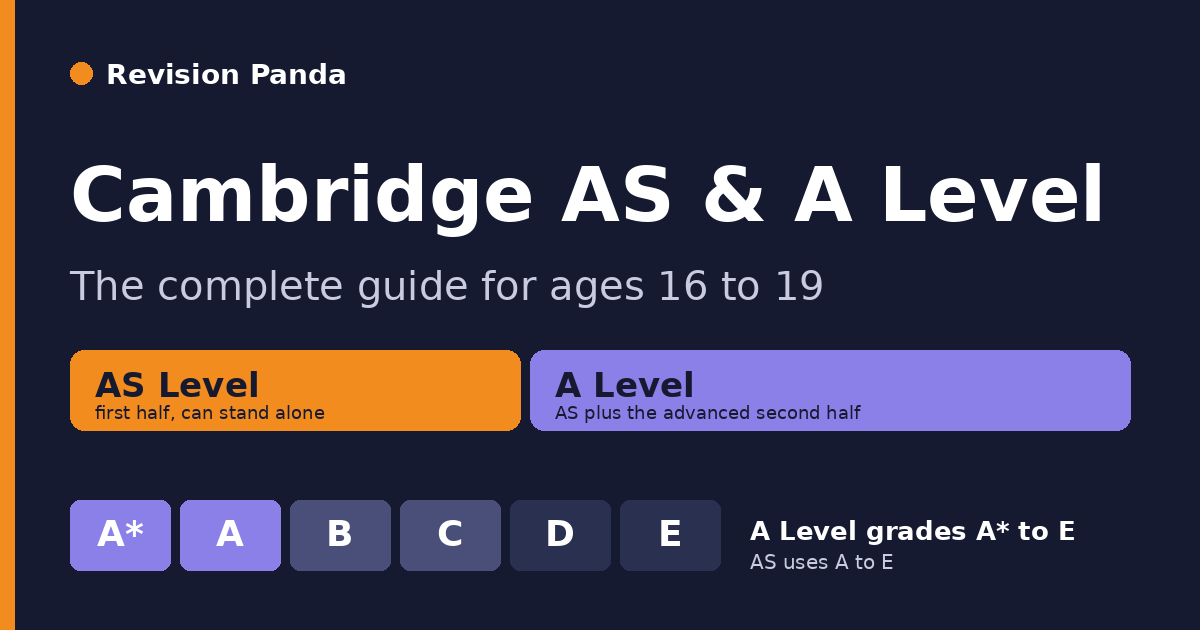
Cambridge AS & A Level is a two-stage advanced qualification for ages 16 to 19. AS Level is the first half and can stand alone, and A Level is the full qualification, graded A* to E.
Cambridge International AS & A Level is the advanced stage of the Cambridge Pathway, typically studied by students aged 16 to 19. Students choose a small number of subjects and study them in depth, then sit externally marked exams. The results are used for university applications in the UK, the US and around the world.
- 16 to 19typical age range
- 1 + 1AS Level is the first half, A Level adds the second
- A* to EA Level grades (AS uses A to E)
- 3assessment routes to choose from
AS Level and A Level: how they fit together
People often treat AS and A Level as the same qualification at different grades. They are not. AS Level is typically a one-year course covering the first half of the A Level content. A Level normally takes two years and includes the AS content plus a more advanced second half. AS Level can stand alone as a qualification, or act as the first step towards the full A Level.
AS Level
- Typically one year
- About half the content of an A Level
- Graded A to E
- Can be taken on its own
A Level
- Normally two years
- AS content plus the advanced second half
- Graded A* to E
- The main qualification for university entry
The A* grade is only available for the full A Level, not for AS. A student who does not reach the standard for grade E receives U, meaning ungraded.
Three routes: which one fits?
Cambridge allows three ways to reach the qualification. Your school decides which routes it offers, and the choice can differ by subject, so ask early.
AS Level only
Students sit the AS papers and stop there. This suits a subject taken for breadth, or a fourth subject alongside three full A Levels.
Staged route
Students sit AS in one exam series, then complete the remaining A Level papers in a later series. This spreads the exam load and gives an early result, but is not possible in every subject.
Linear route
Students take every paper at the end of the course in one series. It suits students who prefer to build understanding across two years before being assessed.
Language AS Levels cannot be carried forward into an A Level. Always check the syllabus for your subject.
The AS and A Level journey
- Before Year 1Choose subjectsPick three or four subjects that fit your goals
- Year 1Study AS contentCover the first half of each syllabus
- End of Year 1AS exams, if stagedAn early result, or a decision point
- Year 2Advanced contentGo deeper and link topics together
- June or NovemberFinal examsResults arrive in August or January
StudyExams
How AS and A Level grading works
A Level results use six grades, from A* (highest) to E. AS Level uses A to E. Cambridge sets grade thresholds, the marks needed for each grade, after every exam series, so they can change from one series to the next.
- A*A Level only
- AHighest AS grade
- BStrong
- CSolid
- DFair
- EMinimum pass
Labels are our plain-language summary. Below E is U, ungraded. See how grade thresholds work.
Exam series and results
| Series | Who mainly sits it | Results issued |
|---|---|---|
| June | Most schools worldwide | August |
| November | Schools on another calendar, and resit candidates | January |
Dates change every year and some syllabuses are not offered in every series. Check the Cambridge calendar. See Cambridge exam dates and results days.
What changes from IGCSE to A Level
Many students find the first term of AS Level harder than expected, even if they did well at IGCSE. The content is not just harder. The way you are expected to learn changes.
Depth over breadth
You study three or four subjects instead of eight or more, so each one goes much deeper and moves faster.
More independence
Teachers set direction, but you are expected to read, practise and fix gaps without being asked.
Harder questions
Exams reward applying ideas to new situations, not repeating memorised answers.
Bigger gaps from IGCSE
Weak algebra or essay skills that you got away with at IGCSE show up quickly. Fix them in the first month.
Choosing your subjects
Most students take three subjects, and some take a fourth. The best choice starts with the course you want to apply for, because universities set their own subject requirements. These are common patterns, not rules.
| If you are aiming for | Subjects often asked for | Worth checking |
|---|---|---|
| Medicine or health sciences | Chemistry, plus biology or another science | Whether maths or a third science is required |
| Engineering | Mathematics and physics | Whether further maths is preferred |
| Computer science or data | Mathematics | Whether computer science is accepted as an A Level |
| Business or economics | Often mathematics, sometimes economics | Subject requirements vary widely by university |
| Humanities and law | Essay-based subjects such as English or history | Whether a specific subject is required |
Always check the entry requirements of the exact courses and countries you are applying to, and ask your school for advice before you finalise.
Subject pages in this series explain the main syllabuses in detail, including Mathematics (9709) and Physics (9702). Chemistry is 9701 and Biology is 9700.
Universities and recognition
Cambridge describes its AS & A Levels as widely recognised and valued by universities, and they are taken in more than 100 countries. In the UK they are accepted for entry to university courses. In the US, many universities accept them too, and some give credit or advanced standing for strong grades, although policies differ. Check each university’s international admissions page for the current position. Our guide to converting grades to US GPA explains how US admissions teams usually read them.
How to prepare well
- Start with the syllabus for each subject and track the topics you have covered.
- Use past papers and mark schemes early, not just before the exams.
- Keep an error log and revisit the topics that appear most often.
- Learn the formulas and definitions you must recall. See our A Level maths formulas.
- Plan a regular weekly study routine, and ask for help as soon as a topic stops making sense.
Questions to ask your school
- Which route do you enter students for in each of my subjects?
- If we follow the staged route, which components do we sit in Year 1?
- Which exam series do you use, and what are the carry-forward rules?
- Where do students from this school usually go after A Level?
The short version
Cambridge AS & A Level is a two-stage, subject-based qualification for ages 16 to 19. AS Level is the first half and can stand alone, while A Level is the full qualification graded A* to E. Choose subjects around your university plans, ask which route your school uses, and build revision habits from the first term.
Choose your curriculumSources and method: Ages, grades, routes and exam series were checked against Cambridge International’s published AS & A Level factsheet and media factsheet. University subject patterns are general examples and must be checked per course. We review this page at least once a year.