US Curriculum Guide: Common Core, AP and High School for International Families
The US has no national curriculum. Each state sets learning standards (most use Common Core or standards based on it), districts choose the curriculum, and students earn a high school diploma by collecting credits from grade 9 to grade 12. Colleges look at GPA and course rigor, such as AP, and often at SAT or ACT scores.
The "American curriculum" means US-style K–12 schooling: kindergarten to grade 12, taught to state standards, assessed course by course and ending in a high school diploma rather than a national exam.
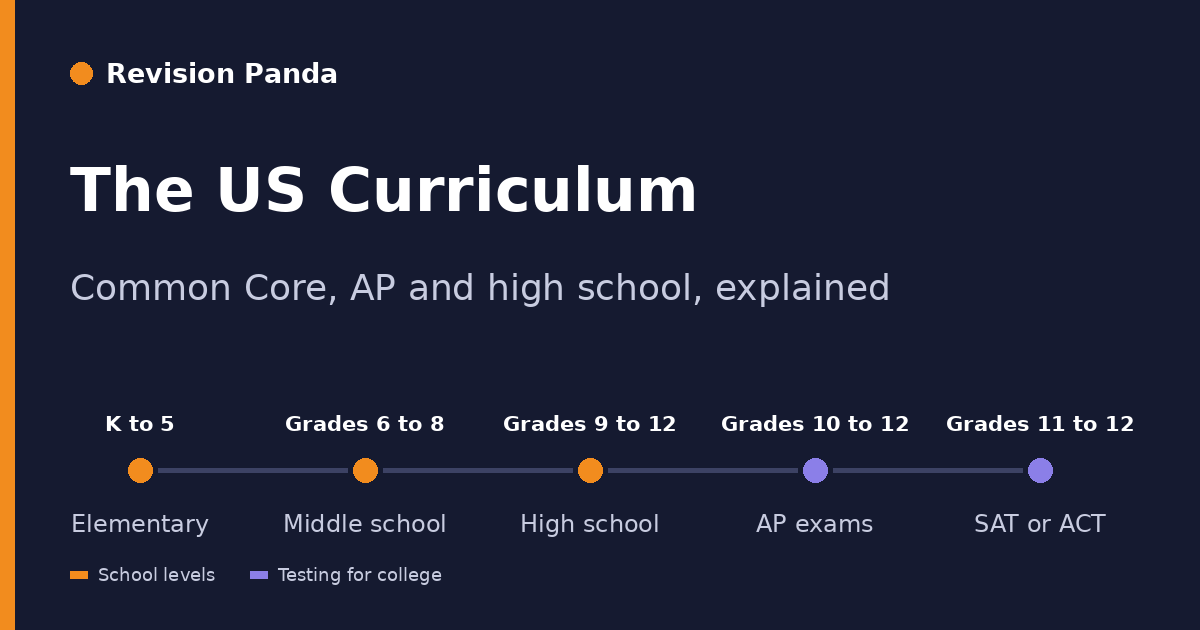
The American curriculum is not one curriculum. The United States has no national syllabus and no national school-leaving exam. Each state sets its own learning standards and graduation rules, and local school districts choose how to teach them. This guide explains how US schooling fits together for international families: grade levels, Common Core, how high school credits and GPA work, what AP courses add, and where the SAT and ACT fit in.
- K–1213 school years, kindergarten to grade 12
- 50states, each setting its own standards
- 1–5AP exam score scale
- May 3–142027 AP exam weeks
Who decides what American students learn?
In the US, education is primarily a state and local responsibility. The US Department of Education describes curriculum, standards and instruction as state and local matters, and federal law prohibits it from directing or controlling school curriculum.
That gives three layers, and families meet all three:
The state
Sets learning standards for each grade, statewide tests and the minimum requirements for a high school diploma.
The school district
Chooses the curriculum, textbooks and course catalog that meet the state standards, and often adds graduation requirements of its own.
The school
Decides which courses it actually offers, including how many AP or honors classes, and how grades and GPA are calculated.
Private schools and homeschooling families usually have more freedom again, depending on state law. The practical lesson for international families: two US high schools, even in the same city, can look quite different on paper. Always ask for the specific school’s course catalog and graduation requirements.
Grade levels: from kindergarten to grade 12
American schooling runs from kindergarten (often written K) through grade 12, which is why it is called K–12. Most districts group the grades into three schools, though the exact split varies (some use K–6, 7–8 and 9–12, or a combined K–8 school).
- Ages 5 to 11Elementary schoolKindergarten to grade 5. One main teacher per class.
- Ages 11 to 14Middle schoolGrades 6 to 8. Subject teachers; some schools offer algebra in grade 8.
- Ages 14 to 16High school, earlyGrades 9 and 10 (freshman, sophomore). Credits and GPA begin to count.
- Ages 16 to 18High school, lateGrades 11 and 12 (junior, senior). AP exams, SAT or ACT, college applications.
- From 18CollegeCommunity college or a four-year college or university.
US grades compared with UK years
A US grade number is one lower than the UK year for the same age. Ages are approximate: each state or district sets the birthday cut-off for starting kindergarten, so a child born close to the cut-off may be placed a year earlier or later than this table suggests.
| US grade | Typical age during the year | School level | UK equivalent (England) |
|---|---|---|---|
| Kindergarten | 5 to 6 | Elementary | Year 1 |
| Grades 1 to 5 | 6 to 11 | Elementary | Years 2 to 6 |
| Grades 6 to 8 | 11 to 14 | Middle school | Years 7 to 9 (Key Stage 3) |
| Grade 9 (freshman) | 14 to 15 | High school | Year 10 |
| Grade 10 (sophomore) | 15 to 16 | High school | Year 11 (GCSE year) |
| Grade 11 (junior) | 16 to 17 | High school | Year 12 |
| Grade 12 (senior) | 17 to 18 | High school | Year 13 |
One big structural difference: there is no GCSE-style exam at 16 in the US. A student moving from England after Year 10 joins grade 10 in the middle of a four-year high school program, and their earlier grades may be counted toward a US transcript. See our GCSE and UK curriculum guide for the English side.
Common Core: standards, not a curriculum
The Common Core State Standards were published in 2010. They set out what students should know and be able to do in math and English language arts at each grade from kindergarten to grade 12. They were written by states, not the federal government, and most states adopted them.
Two points cause most of the confusion:
What Common Core is
- A list of grade-by-grade goals in math and English language arts
- A shared reference point used, in some form, by most states
- Focused on fewer topics per year, studied in more depth
What it is not
- Not a curriculum: it sets no lessons, textbooks or reading lists
- Not national: each state chooses its own standards
- Not universal: several states renamed, revised or replaced it
Since 2010 the picture has become messier. Some states still use the Common Core name. Many kept most of the content under a new state-specific name. A few, including Texas and Virginia, never adopted it, and Florida replaced it with its own B.E.S.T. standards. Science is separate: many states base their science standards on a different framework, and social studies standards are set state by state.
For families, the useful question is not “Does this school use Common Core?” but “What are this state’s standards for my child’s grade, and what curriculum does the school use to teach them?” The state department of education publishes its standards online.
How US high school works: credits, transcript and diploma
A US high school diploma is earned course by course over four years, not through a single final exam. The building blocks are credits.
Credits
Graduation requirements are usually counted in credits, also called Carnegie units. One credit is roughly one year-long course, so “4 credits of English” means four years of English.
Required and elective courses
States and districts require set credits in English, math, science and social studies, plus courses such as physical education. Students fill the remaining credits with electives.
The transcript
Every course and its final grade goes on the student’s transcript. Colleges read the transcript from grades 9 to 12, so grade 9 matters more than many families expect.
Most states require somewhere between 20 and 24 credits for a standard diploma, but the range is wide, a few states leave graduation requirements to local districts, and some use different credit systems altogether. Some states also require a state exam or other non-course requirements to graduate.
What a typical four-year plan looks like
This is an illustration, not a rule. Requirements differ by state and district, and many students take more than the minimum.
| Subject area | A common minimum | What students usually take |
|---|---|---|
| English | 4 credits | One English course each year |
| Math | 3 to 4 credits | Algebra 1, geometry, algebra 2, then precalculus, statistics or calculus |
| Science | 2 to 4 credits | Biology, chemistry, physics or environmental science, often with labs |
| Social studies | 3 to 4 credits | World history, US history, government and economics |
| World languages | Varies | Often 2 or more years; many colleges expect them even where the state does not |
| Electives and other | The remainder | Arts, computer science, physical education, career courses, more advanced classes |
Notice the difference from the UK and Cambridge systems: a US student keeps studying English, math, science and social studies to age 18, rather than narrowing to three or four subjects at 16. Our comparison of Cambridge IGCSE and US high school goes into this in more detail.
GPA: the number colleges look at first
US schools usually give letter grades (A, B, C, D and F) for each course, and turn them into a grade point average (GPA). On the most common unweighted scale an A is worth 4 points, a B 3, a C 2, a D 1 and an F 0, and the GPA is the average across all courses.
Unweighted GPA
Every course counts the same, so the maximum is usually 4.0. It shows how well a student did, but not how hard their courses were.
Weighted GPA
Many schools add extra points for honors, AP or IB courses, so a weighted GPA can go above 4.0. How much extra is added varies from school to school.
There is no national GPA standard. Schools differ in plus and minus grades, weighting and which courses count, and colleges know this: many recalculate GPA in their own way and look at the difficulty of the courses as well as the number. For a student arriving with Cambridge or UK grades, ask the school how it will record earlier work on the transcript.
AP: college-level courses in high school
Advanced Placement (AP) is a program run by the College Board, a nonprofit organization. Each AP course follows a College Board course framework and ends with a standardized AP exam in May. Courses are usually taken in grades 10 to 12, and no school offers every subject.
- 5Extremely well qualified
- 4Very well qualified
- 3Qualified
- 2Possibly qualified
- 1No recommendation
AP exams are scored from 1 to 5. A 3 is described as “qualified”, and many US colleges give credit or advanced placement for a 3 or above, but selective universities often require a 4 or 5, and policies differ by college and by subject. Scores are usually released in July.
What AP can do for a student
- Show colleges that a student chose demanding courses
- Earn college credit or let a student skip an introductory course
- Raise a weighted GPA at schools that weight AP courses
What to keep in mind
- The AP exam is separate from the course grade on the transcript
- Students register for exams through their school, not directly
- Outside the US, credit depends entirely on each university
The 2027 AP exams run over two weeks in May: May 3–7 and May 10–14, with late testing available for students who cannot test during those weeks. Our AP exam dates 2027 guide lists every subject by day.
AP is not the only advanced option. Many high schools also offer honors courses (harder versions of regular classes, set by the school), the International Baccalaureate (IB) Diploma Programme, or dual enrollment, where students take real college courses through a local college while still in high school.
Where the SAT and ACT fit in
The SAT and ACT are college admissions tests. They are not part of the high school curriculum and are not needed to graduate, though some states use them as their official high school test. Students usually take them in grade 11 or early grade 12, and can take them more than once.
| SAT | ACT | |
|---|---|---|
| Run by | College Board | ACT |
| Sections | Reading and Writing; Math | English, Math and Reading; Science and Writing are optional |
| Score range | 400 to 1600 (two sections of 200 to 800) | Composite of 1 to 36, the average of English, Math and Reading |
| Format | Digital and adaptive, 2 hours 14 minutes | Online or on paper; the shorter “enhanced” ACT was introduced from 2025 |
Whether a student needs either test depends on the college. Some require scores, many are test-optional, and policies have changed several times in recent years, so check each college’s current admissions page for the year you apply. The PSAT, taken by many students in grade 10 or 11, is a practice version of the SAT that can also lead to scholarship recognition. For help choosing, see SAT vs ACT for international students.
A typical path through high school
Every school is different, but this is the rhythm most college-bound students follow. Note the US names for high school years: a “junior” is in grade 11, not a younger child.
Grade 9 (freshman year)
The transcript starts. Students take core courses, often including honors options, and begin building a GPA that colleges will see.
Grade 10 (sophomore year)
Many students take a first AP course. Some take the PSAT for practice. Course choices start to show colleges a direction.
Grade 11 (junior year)
Usually the heaviest academic year: more AP courses, the PSAT, and a first SAT or ACT. Students start researching colleges.
Grade 12 (senior year)
College applications are typically due between November and January. Students finish graduation requirements and take final AP exams in May.
Graduation
Students who meet their state and district requirements receive a high school diploma, usually in May or June.
What this means for international families
Moving to the US
Placement is by age and by the credits a student brings. Bring report cards and course descriptions, translated if needed, so the school can award credit for completed work. Ask early how many credits will transfer, because it affects whether a student can graduate on time.
At an “American” school abroad
International schools that describe themselves as American usually follow US-style standards (often Common Core based), award a US-style diploma and offer AP or IB. Ask which state’s standards they follow and which body accredits the school.
Switching in grades 11 or 12
This is the hardest point to move. Graduation requirements accumulate over four years, and missing a required course such as US history can delay a diploma. Get the school’s written graduation plan before you commit.
Applying to UK or other universities
Universities outside the US often ask US applicants for AP scores, SAT or ACT results, or IB, not just the diploma and GPA. If a UK university is a possibility, check its US entry requirements early. Our AS & A Level guide covers the Cambridge route for comparison.
Questions to ask the school
- Which state standards do you follow, and what curriculum do you use to teach them?
- What are your graduation requirements, including any district or state exams on top of credits?
- How will you place my child, and how many credits will transfer from their previous school?
- Which AP, honors, IB or dual enrollment courses do you offer, and from which grade?
- How do you calculate GPA: weighted or unweighted, and on what scale?
- Do you offer the PSAT, SAT or ACT at school, and when?
- How do you support students applying to colleges outside the US?
- For schools abroad: who accredits the school, and is the diploma recognized in the countries we are considering?
The short version
US schooling runs from kindergarten to grade 12, with no national curriculum and no national exam at 16. States set standards (most use Common Core or something close to it), districts set the curriculum, and students earn a diploma by collecting credits over four years of high school. Colleges look at the transcript and GPA first, then at course rigor, such as AP classes scored 1 to 5, and often at SAT or ACT scores where the college asks for them.
Choose your curriculumSources and method. Federal and state roles: US Department of Education, ‘Federal Role in Education’. Common Core status: Education Week reporting and state department of education standards pages; state adoption changes over time, so check your state. Credits and graduation requirements: Education Commission of the States, 50-state comparison of high school graduation requirements, and NCES state policy tables. AP scores and 2027 exam dates: College Board AP Students and AP Central. SAT format and score ranges: College Board SAT Suite. ACT format and scoring: ACT test enhancements pages. GPA practice varies by school; the scale shown is the most common unweighted version, not a national standard. We review this page every year before the AP exam season. Last checked November 2026.