Cambridge IGCSE Grading, Exam Dates and Results Explained
Cambridge IGCSE grades run from A* to G (9 to 1 in some syllabuses). Each grade depends on a minimum raw mark, called a threshold, that Cambridge sets after every exam series.
A grade threshold is the minimum raw mark needed for a grade in a given exam series.
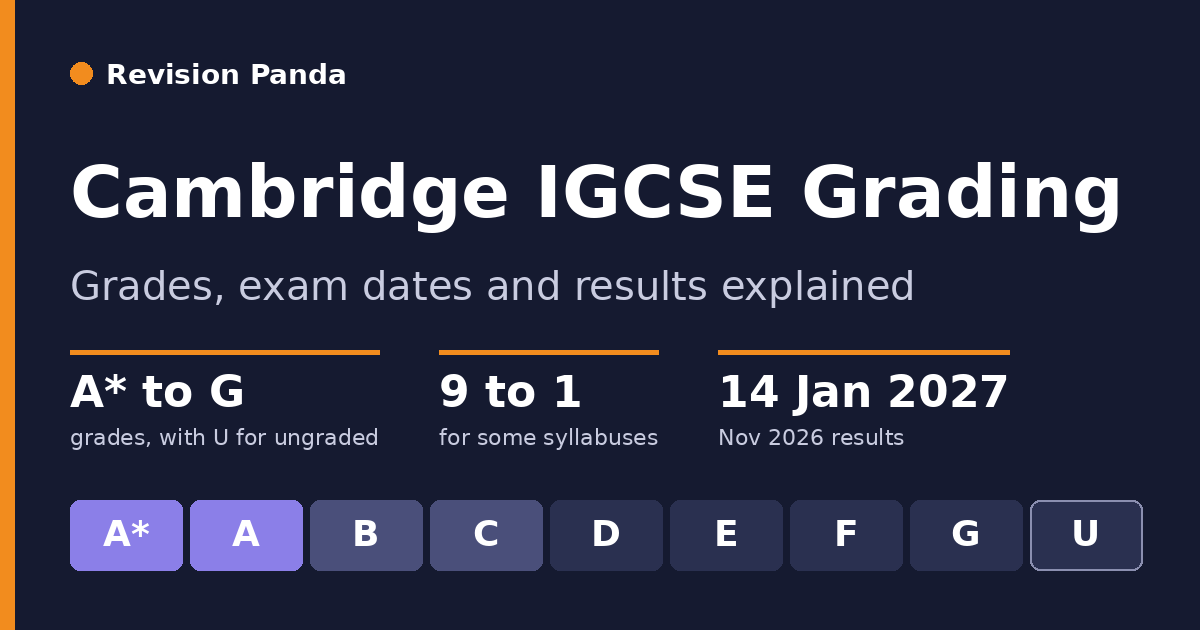
Cambridge IGCSE is a two-year international qualification, usually taken at ages 14 to 16. Students choose their subjects, study for two years and sit externally marked exams, mostly in June or November. It is part of the Cambridge Upper Secondary stage and is a common route into A Levels and other post-16 courses.
- 14 to 16typical age range
- 2 yearsof study in most schools
- A* to Ggrades, with 9 to 1 in some syllabuses
- 2main exam series: June and November
What Cambridge IGCSE is
IGCSE stands for International General Certificate of Secondary Education. It is offered by Cambridge and taught in schools around the world. Cambridge describes it as the world’s most popular international qualification for 14 to 16 year olds, and it is recognised by many universities and employers.
Students take individual subjects and receive a separate grade for each one. Most students study several subjects at once. They are assessed mainly through written exams, with practical, oral or coursework components in some subjects. If you are new to the wider system, start with our Cambridge Pathway guide.
How the two years work
Most students follow the same five steps. The route shows where preparation ends and exams begin.
- Before the courseChoose subjectsPick subjects with A Level and career plans in mind
- Year 1Learn the syllabusCover the topics and build exam skills
- Year 2Revise and practiseUse past papers and fix weak topics
- June or NovemberSit the examsExternally marked papers in a Cambridge series
- August or JanuaryReceive resultsGrades arrive a few months after each series
PreparationExams and results
Choosing IGCSE subjects
Schools can usually offer subjects in many combinations, so the real question is which ones to choose. The best starting point is what your child wants to study next.
Core subjects
English, mathematics and the sciences (biology, chemistry, physics). Most universities and sixth forms expect strong results here, so these are rarely optional in practice.
Languages and humanities
First and second languages, plus subjects such as history, geography and economics. These build writing, analysis and communication skills.
Creative and technical
Subjects such as art and design, music and computer science. They broaden a timetable and can support later study in creative or technical fields.
Available subjects differ by school and country. Check the official syllabus page for each subject’s code and assessment details. Examples: Mathematics 0580, Physics 0625, Chemistry 0620 and Biology 0610.
Core and Extended tiers
Many subjects offer two tiers so that papers match a student’s level. Teachers usually choose the tier. It matters because it limits the highest grade a student can reach.
| Tier | Who it suits | Grades available |
|---|---|---|
| Core | Students covering the essential content of a subject | C to G |
| Extended | Students ready for more content and more demanding questions | A* to E |
Tier names, content and grade ranges can vary by subject. Check the syllabus for yours.
How IGCSE grading works
Cambridge IGCSE results use eight grades, from A* (the highest) to G. A student who does not reach the standard for G receives U, meaning ungraded.
- A*Highest
- AExcellent
- BStrong
- CSolid
- DFair
- EBasic
- FLimited
- GLowest
- UUngraded
The descriptive labels are our plain-language summary. Cambridge publishes the official grade descriptions for each syllabus.
Some syllabuses, offered to schools in some regions, use Cambridge IGCSE (9–1) instead, where 9 is the top grade. The syllabus name shows which scale applies. Grade thresholds, meaning the marks needed for each grade, are set after every exam series, so they can change. See our guide to IGCSE grading, thresholds and results dates.
Exam series and results
Cambridge runs exams in set series. Most schools use June. Some schools, often in the southern hemisphere, use November, and students also resit single subjects then.
| Series | Who mainly sits it | Results issued |
|---|---|---|
| June | Most schools worldwide | August |
| November | Schools on a different calendar, and resit candidates | January |
| March | Available only for some syllabuses, in India | Check the Cambridge calendar |
Dates change every year and not every syllabus is offered in every series. Confirm on the Cambridge International website or with your exam centre.
How IGCSE is assessed
Written papers
Most subjects are assessed mainly by written exams. They are set and marked by Cambridge, not by the school, so every student is judged to the same standard.
Practical work
Science subjects include either a practical test or a written alternative to practical. Your school decides which one students sit.
Oral and coursework
Some subjects, such as languages and art, include speaking or coursework components. Check each syllabus, because this varies.
Private candidates
Students who do not attend a Cambridge school can often enter through an authorised exam centre. Subjects with coursework or practicals can be harder to take this way.
After IGCSE: what comes next
IGCSE is usually a foundation for further study rather than an end point. Cambridge says it prepares students for courses such as AS & A Level. Common next steps include:
Cambridge AS & A Level
The most common next step for Cambridge students. Read our AS & A Level guide.
Other post-16 routes
Depending on the school, students may move to the IB, AP courses or other local pathways.
University and work
Entry rules vary, so check the exact requirements of the courses and countries you are aiming for.
IGCSE and GCSE at a glance
IGCSE was developed as an international counterpart to the UK’s GCSE. They sit at a similar level but are built for different systems.
| Feature | Cambridge IGCSE | GCSE (England) |
|---|---|---|
| Built for | Students worldwide | The UK school system |
| Typical age | 14 to 16 | 14 to 16 |
| Grading | A* to G in most syllabuses, 9 to 1 in some | 9 to 1 |
| Exam series | June and November | Mainly summer |
Read the full GCSE and UK curriculum guide for more detail.
How to prepare well
- Learn the syllabus for each subject and tick off topics as you cover them.
- Practise with past papers under timed conditions, then mark them honestly.
- Keep a log of repeated mistakes and revisit those topics every week.
- Learn the key formulas early. See our IGCSE maths formulas.
- Ask your teacher which tier and which exam series you are entered for.
Questions to ask your school
- Which IGCSE subjects and tiers will my child take?
- Which exam series will we use, and when are the results?
- Are the sciences assessed with a practical test or the written alternative?
- What do students usually do after IGCSE at this school?
The short version
Cambridge IGCSE is a two-year, subject-by-subject qualification for ages 14 to 16, graded A* to G (9 to 1 in some syllabuses) and examined mainly in June and November. Choose subjects with the next step in mind, learn each syllabus, and practise with past papers.
Choose your curriculumSources and method: Ages, grading, exam series and results timing were checked against Cambridge International’s Cambridge IGCSE qualification page. Tier and assessment details vary by syllabus, so check each subject’s official syllabus. We review this page at least once a year.