Cambridge Pathway Explained: Ages 3 to 19 | Revision Panda
The Cambridge Pathway is Cambridge’s framework for students aged 3 to 19, with five stages: Early Years, Primary, Lower Secondary, Upper Secondary (IGCSE or O Level), and Advanced (AS & A Level)
A connected sequence of Cambridge stages, each building on the last.
- Ages 3 to 19, five stages, Checkpoint tests at Primary and Lower Secondary, formal qualifications from Upper Secondary.
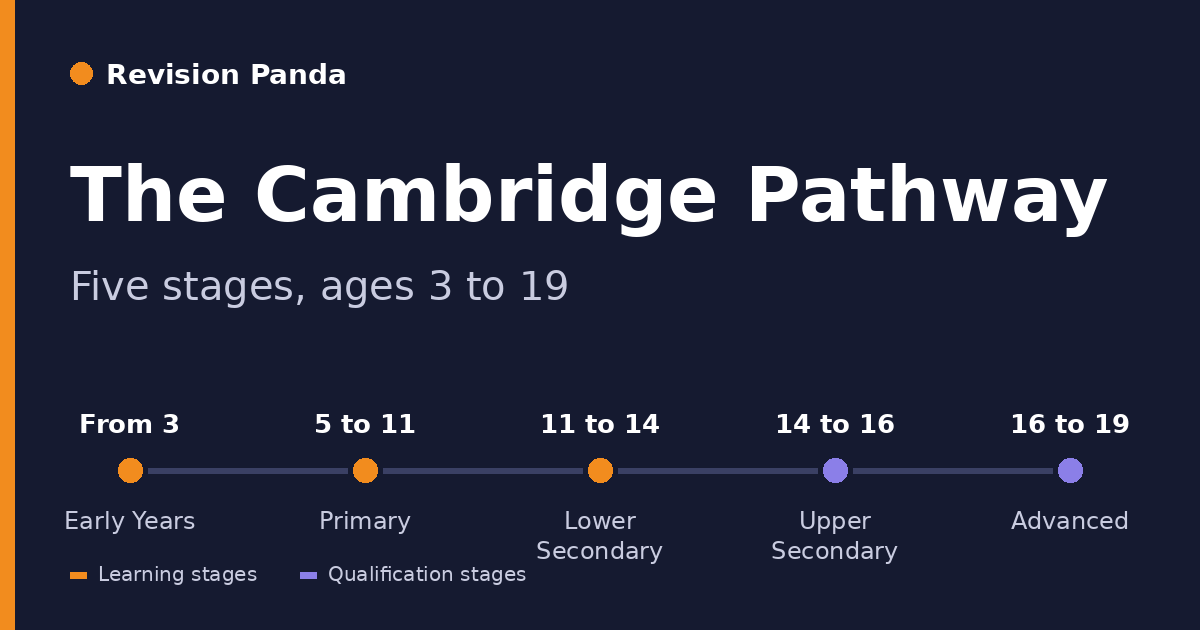
The Cambridge Pathway is Cambridge’s learning framework for students aged 3 to 19. It runs from Early Years to Advanced (AS & A Level), and each stage is designed to prepare students for the next. Schools can offer every stage or just some of them.
- 5stages, from Early Years to Advanced
- 3 to 19the age range it covers
- 2optional Checkpoint stages
- 3formal qualifications: IGCSE, O Level, AS & A Level
The pathway at a glance
Read it from left to right. Orange stages are learning stages. Indigo stages end in formal, externally marked qualifications.
- From age 3Early YearsEarly learning and curiosity before formal schooling
- Ages 5 to 11PrimaryCore skills in English, maths and science
- Ages 11 to 14Lower SecondaryA broad programme that prepares for IGCSE
- Ages 14 to 16Upper SecondaryIGCSE or O Level subject qualifications
- Ages 16 to 19AdvancedAS & A Level, preparing for university
Learning stageQualification stage
Age bands are typical, not strict, and names can vary by country and school. Some Cambridge pages for US schools call the stage before Advanced “Pre-Advanced”.
What happens at each stage
Cambridge Early Years
From age 3What students do
Play-based learning that builds language, number sense, curiosity and early social skills.
How progress is checked
It is a foundation stage, not an exam stage. Teachers observe and support rather than test.
Worth knowing
Not every Cambridge school offers it, so check whether your school starts at Early Years or Primary.
Cambridge Primary
Ages 5 to 11What students do
Build secure foundations in English, mathematics and science, alongside a wider set of subjects such as art and music.
How progress is checked
Schools can enter students for optional Primary Checkpoint tests at the end of the stage. They are marked by Cambridge and give an outside benchmark.
Worth knowing
Strong reading, number skills and confidence matter most here, because every later stage builds on them.
Cambridge Lower Secondary
Ages 11 to 14What students do
Carry Primary subjects forward with more challenge and independence, and start to think more analytically.
How progress is checked
Optional Lower Secondary Checkpoint tests, typically in English, mathematics and science, show strengths and gaps before IGCSE begins.
Worth knowing
This is the best time to fix weak spots in algebra, number and writing, before exam courses start.
Cambridge Upper Secondary
Ages 14 to 16What students do
Follow Cambridge IGCSE or Cambridge O Level in the subjects they choose. Schools can usually offer subjects in many combinations.
How progress is checked
Externally marked exams in set exam series. This is where formal grades begin.
Worth knowing
Subject choices here affect what students can study later, so check A Level and university requirements early. See our IGCSE guide.
Cambridge Advanced
Ages 16 to 19What students do
Study fewer subjects in more depth, usually as AS & A Levels, with a focus on university and further study.
How progress is checked
AS & A Level exams. Results are used for university applications, so grades and subject combinations carry more weight.
Worth knowing
Universities set their own entry requirements. See our AS & A Level guide.
Learning stages and qualification stages
The most common confusion is thinking every stage ends in an exam. It doesn’t. This table shows the difference.
| Stage | Type | Formal qualification? | External tests |
|---|---|---|---|
| Early Years | Learning stage | No | None |
| Primary | Learning stage | No | Optional Primary Checkpoint |
| Lower Secondary | Learning stage | No | Optional Lower Secondary Checkpoint |
| Upper Secondary | Qualification stage | Yes: IGCSE or O Level | Exam series |
| Advanced | Qualification stage | Yes: AS & A Level | Exam series |
Which stage is your child in?
Match your child’s age to a Cambridge stage, a UK school year and a US grade. School systems start at different times of year, so treat this as a starting point and confirm with the school.
| Age | Cambridge stage | UK year | US grade |
|---|---|---|---|
| 3 to 4 | Early Years | Nursery and Reception | Pre-K |
| 5 to 11 | Primary | Years 1 to 6 | Grades K to 5 |
| 11 to 14 | Lower Secondary | Years 7 to 9 | Grades 6 to 8 |
| 14 to 16 | Upper Secondary | Years 10 to 11 | Grades 9 to 10 |
| 16 to 19 | Advanced | Years 12 to 13 | Grades 11 to 12 |
Joining part-way: what to check first
You do not have to start at the beginning. Many students join at IGCSE or A Level, especially when they move between schools or countries. The right checks depend on where they come from.
From the UK system
Year 9 to 10 is a natural point to begin IGCSE. Compare GCSE and IGCSE subject content, and confirm which exam series the school uses. Start with our GCSE and UK curriculum guide.
From the US system
Grade 9 or 10 usually lines up with Upper Secondary. Check maths level, because IGCSE maths expects confident algebra, and check how sciences are taught. See the US curriculum guide.
From another system
Ask the school for a placement or diagnostic check in maths and English. These two subjects hold up every later stage, so gaps there matter most.
Four things families often get wrong
“IGCSE is the whole pathway”
IGCSE is one qualification within Upper Secondary. The pathway starts earlier and continues to Advanced.
“Every stage has exams”
Early Years, Primary and Lower Secondary are learning stages. Their Checkpoint tests are optional and school-led.
“Primary and Lower Secondary are the same”
They connect, but Lower Secondary adds more challenge, analysis and independence.
“Every Cambridge school is the same”
Schools choose which stages and subjects to offer, so always ask what your school covers.
Questions to ask your school
- Which Cambridge stages do you teach, and from what age?
- Do students sit Primary or Lower Secondary Checkpoint tests?
- Which IGCSE or O Level subjects can my child choose, and in which exam series?
- How are students supported when they join part-way through the pathway?
- Which universities and countries do your students usually apply to?
What this means for exams and universities
Cambridge says its qualifications are recognised by universities and employers around the world. In practice, universities set their own entry requirements, so always check the courses and countries your child is aiming for.
The short version
The Cambridge Pathway is a five-stage route from age 3 to 19. The first three stages build skills, and the last two lead to formal qualifications. Find your child’s stage, ask your school what it offers, and plan subject choices early.
Choose your curriculumSources and method: Stage names and age ranges were checked against Cambridge International’s pages on the Cambridge Pathway (international and US versions). The UK-year and US-grade mapping is approximate. Cambridge may update stage names or ages, so we review this page at least once a year.
What is the Cambridge Pathway?
It is Cambridge's curriculum framework for ages 5 to 19, running through Primary, Lower Secondary, Upper Secondary (IGCSE) and Advanced (AS & A Level) stages so that learning builds step by step.