Geometry Formulas: The Complete Reference (Area, Perimeter, Volume)
The core geometry formulas are: rectangle area l × w; triangle area ½ × b × h; circle area πr² and circumference 2πr; prism and cylinder volume = cross-section area × length (πr²h for a cylinder); cone and pyramid volume = ⅓ × base area × height; sphere volume ⁴⁄₃πr³ and surface area 4πr².
Geometry formulas are standard rules for calculating the size of shapes: area and perimeter for flat 2D shapes, and volume and surface area for 3D solids
Every geometry formula you need for school maths, in one place. This reference covers area and perimeter of 2D shapes, volume and surface area of 3D solids, circles, sectors and arcs, Pythagoras’ theorem, trigonometry, angle facts and coordinate geometry. Each formula has a worked example, and the same formulas apply whether you study Cambridge IGCSE, GCSE, A Level or a US high school course.
- 92D shapes with area and perimeter
- 83D solids with volume and surface area
- π ≈ 3.142used in every circle, cylinder, cone and sphere formula
- 1set of formulas, used worldwide
How to use this page
Find the shape, read the formula, then check the worked example to see it used. Formulas are grouped by type: flat shapes first, then circles, then solids, then the tools that connect them (Pythagoras, trigonometry, angles and coordinates).
The formulas themselves are the same in every country and every exam. What changes is which ones you are given on a formula sheet and which you must memorise, so check the rules for your own exam. For example, Cambridge IGCSE Mathematics (0580) prints a formula sheet at the front of every paper from 2025; our IGCSE Mathematics 0580 guide explains what is on it.
Key to letters: l length, w width, b base, h perpendicular height, r radius, d diameter, a and b parallel sides or side lengths, θ angle, l (cones) slant height. ‘Perpendicular height’ always means the height measured at right angles to the base.
2D shapes: area and perimeter
Area measures the space inside a flat shape, in square units (cm², m²). Perimeter is the distance around the outside, in ordinary length units (cm, m).
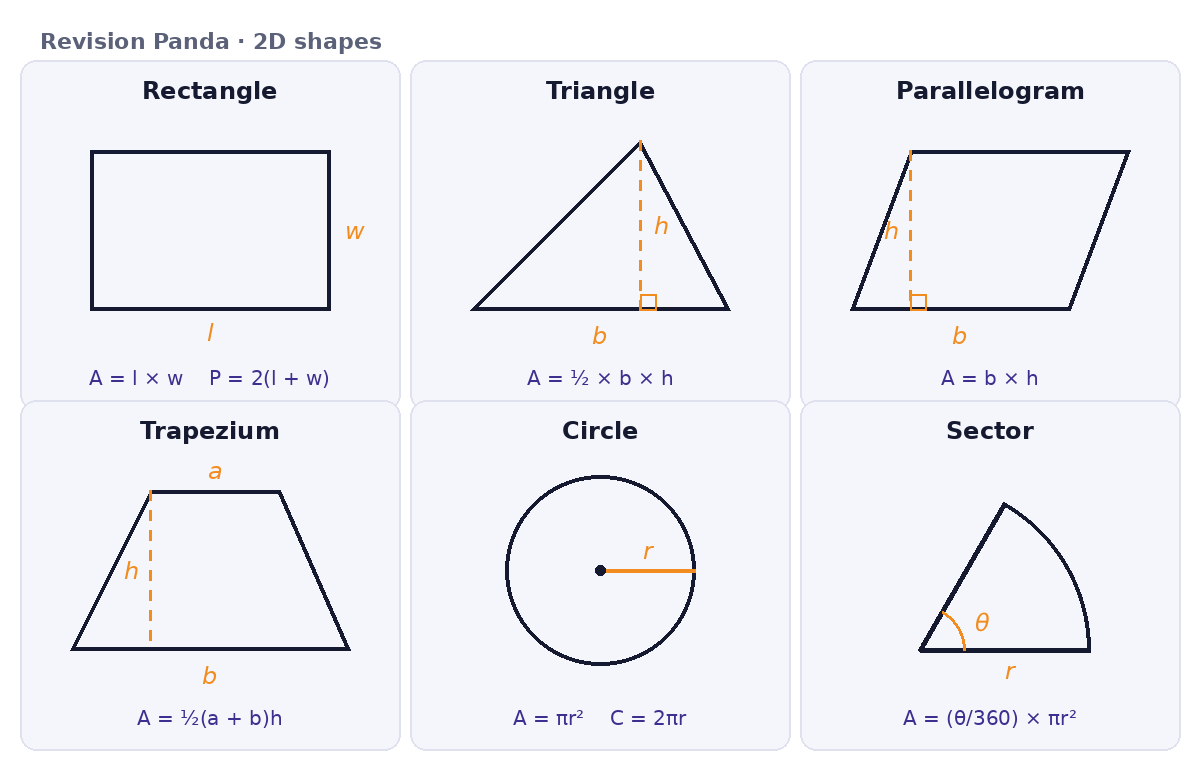
| Shape | Area | Perimeter | Worked example |
|---|---|---|---|
| Square (side s) | s² | 4s | s = 7 cm: area 49 cm², perimeter 28 cm |
| Rectangle | l × w | 2(l + w) | 8 cm by 5 cm: area 40 cm², perimeter 26 cm |
| Triangle | ½ × b × h | Add the three sides | b = 10 cm, h = 6 cm: area 30 cm² |
| Triangle (two sides and included angle) | ½ab sin C | Add the three sides | a = 7, b = 9, C = 30°: area = ½ × 7 × 9 × 0.5 = 15.75 |
| Parallelogram | b × h | 2 × (sum of two adjacent sides) | b = 12 cm, h = 5 cm: area 60 cm² |
| Trapezium (US: trapezoid) | ½(a + b)h | Add the four sides | a = 6, b = 10, h = 4: area = ½ × 16 × 4 = 32 |
| Rhombus or kite (diagonals p, q) | ½ × p × q | Add the four sides | Diagonals 8 cm and 6 cm: area 24 cm² |
| Circle | πr² | Circumference 2πr = πd | r = 5 cm: area 78.5 cm², circumference 31.4 cm |
| Ellipse (semi-axes a, b) | πab | No simple exact formula | a = 4, b = 2: area = 8π ≈ 25.1 |
The parallelogram and triangle formulas are closely linked. Any parallelogram can be cut into two identical triangles, which is why the triangle area is half of base times height. A trapezium’s area is the average of its parallel sides times the height. Understanding these links means you can rebuild a formula you have forgotten.
Circles, arcs and sectors
A sector is a ‘pizza slice’ of a circle and an arc is the curved edge of that slice. Both are a fraction of the full circle, and the fraction is the angle at the centre divided by 360°.
| Quantity | Formula (angle in degrees) | Worked example (r = 6 cm, θ = 60°) |
|---|---|---|
| Arc length | (θ ÷ 360) × 2πr | (60 ÷ 360) × 12π = 2π ≈ 6.28 cm |
| Sector area | (θ ÷ 360) × πr² | (60 ÷ 360) × 36π = 6π ≈ 18.8 cm² |
| Sector perimeter | Arc length + 2r | 6.28 + 12 = 18.3 cm |
In radians (A Level)
When the angle θ is in radians, arc length = rθ and sector area = ½r²θ. The degree versions above become these because a full turn is 2π radians.
Radius or diameter?
Questions often give the diameter. Halve it before using any formula that needs r. Using the diameter in πr² gives an area four times too big.
3D solids: volume and surface area
Volume measures the space inside a solid, in cubic units (cm³, m³). Surface area is the total area of every face, in square units.
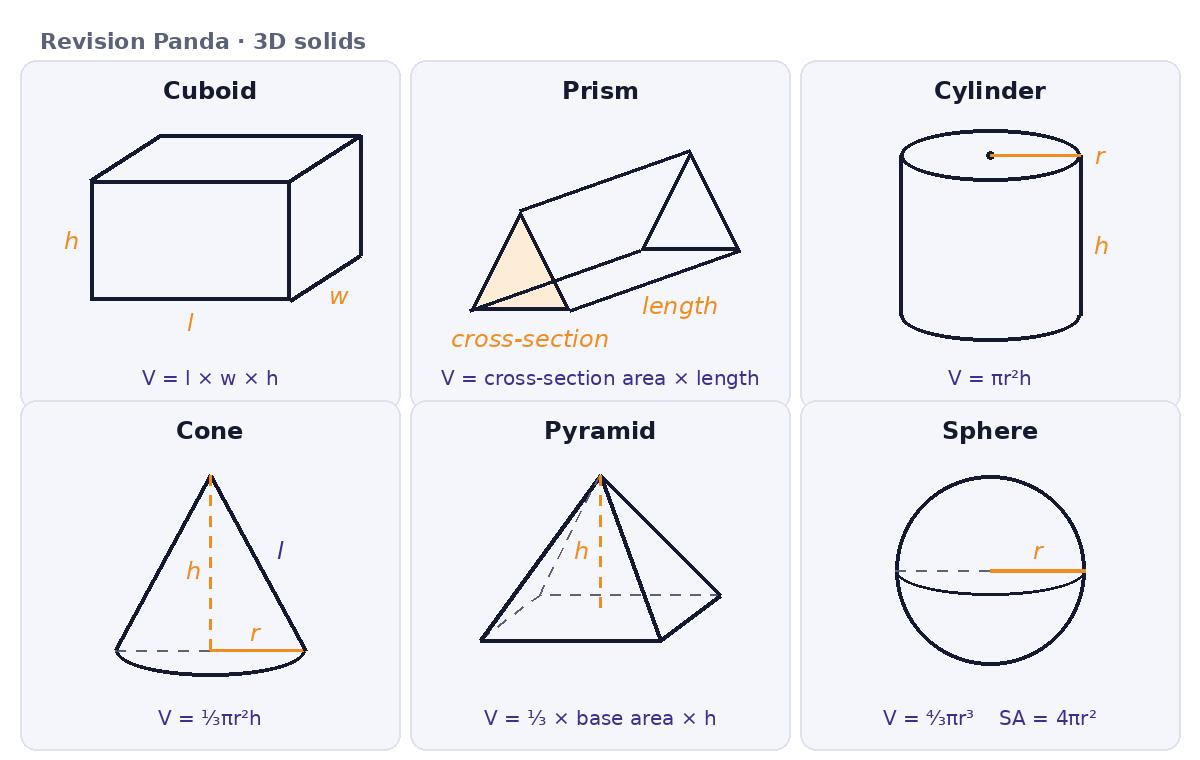
| Solid | Volume | Surface area | Worked example |
|---|---|---|---|
| Cube (edge a) | a³ | 6a² | a = 4 cm: volume 64 cm³, surface area 96 cm² |
| Cuboid (rectangular box) | l × w × h | 2(lw + lh + wh) | 5 × 3 × 2 cm: volume 30 cm³, surface area 2(15 + 10 + 6) = 62 cm² |
| Prism (any constant cross-section) | Area of cross-section × length | Add the areas of all faces | Triangular cross-section 12 cm², length 10 cm: volume 120 cm³ |
| Cylinder | πr²h | 2πr² + 2πrh | r = 3, h = 10: volume 90π ≈ 283 cm³, surface area 78π ≈ 245 cm² |
| Cone | ⅓πr²h | πrl + πr², where l = √(r² + h²) | r = 3, h = 4, so l = 5: volume 12π ≈ 37.7 cm³, surface area 24π ≈ 75.4 cm² |
| Pyramid | ⅓ × base area × h | Base area + area of each triangular face | Square base 6 cm, h = 4 cm: volume 48 cm³; each face has slant height 5 cm, so surface area 36 + 4 × 15 = 96 cm² |
| Sphere | ⅔πr³ | 4πr² | r = 6 cm: volume 288π ≈ 905 cm³, surface area 144π ≈ 452 cm² |
| Hemisphere | ⅔πr³ | 3πr² (curved surface 2πr² plus the flat circle πr²) | r = 6 cm: volume 144π ≈ 452 cm³, total surface area 108π ≈ 339 cm² |
The prism rule
Cubes, cuboids and cylinders are all prisms: volume is always cross-section area times length. Learn this one idea and three formulas follow from it.
The one-third rule
A cone or pyramid has exactly one third of the volume of the prism or cylinder with the same base and height. That is where the ⅓ comes from.
Slant height vs height
Cone volume uses the perpendicular height h; the curved surface area uses the slant height l. Pythagoras links them: l² = r² + h².
For more on solids, including frustums, composite shapes and surface area nets, see our volume and surface area formulas guide.
Composite shapes: putting formulas together
Exam questions often combine two or more shapes. The method is always the same: split the shape into parts you know, find each part, then add (or subtract for holes).
2D: a rectangle with a semicircle
A rectangle 10 cm by 6 cm has a semicircle on one 6 cm end.
Area = rectangle + half circle = 60 + ½ × π × 3² = 60 + 4.5π ≈ 74.1 cm².
Perimeter = 10 + 10 + 6 (the three straight sides) + half the circumference, π × 3 ≈ 9.42. Total ≈ 35.4 cm. The straight side under the semicircle is inside the shape, so it is not counted.
3D: a cylinder with a hemisphere on top
A cylinder of radius 3 cm and height 10 cm has a hemisphere of radius 3 cm on top.
Volume = cylinder + hemisphere = π × 3² × 10 + ⅔ × π × 3³ = 90π + 18π = 108π ≈ 339 cm³.
Leaving the answer as 108π is the exact form, often asked for on non-calculator papers.
Similar shapes: scale factors for length, area and volume
Two shapes are similar when one is an enlargement of the other. If lengths are multiplied by a scale factor k, areas are multiplied by k² and volumes by k³.
| Measure | Scale factor | Example with k = 3 |
|---|---|---|
| Length (sides, perimeter, height) | k | A 4 cm side becomes 12 cm |
| Area (faces, surface area) | k² | A 20 cm² face becomes 20 × 9 = 180 cm² |
| Volume (and mass, for the same material) | k³ | A 15 cm³ solid becomes 15 × 27 = 405 cm³ |
This is the same idea as the unit conversions below: squaring for area and cubing for volume. Working backwards, if you know the ratio of two areas, square-root it to find the length scale factor.
Pythagoras’ theorem and trigonometry
These formulas find missing sides and angles, which you often need before you can use an area or volume formula.
| Rule | Formula | When to use it | Worked example |
|---|---|---|---|
| Pythagoras’ theorem | a² + b² = c² (c is the hypotenuse) | Right-angled triangle, two sides known, find the third | Sides 6 and 8: c = √(36 + 64) = 10 |
| Sine ratio | sin θ = opposite ÷ hypotenuse | Right-angled triangle, sides and angles | Hypotenuse 10, θ = 30°: opposite = 10 × 0.5 = 5 |
| Cosine ratio | cos θ = adjacent ÷ hypotenuse | Right-angled triangle | Hypotenuse 10, θ = 60°: adjacent = 10 × 0.5 = 5 |
| Tangent ratio | tan θ = opposite ÷ adjacent | Right-angled triangle | Opposite 5, adjacent 5: tan θ = 1, so θ = 45° |
| Sine rule | a ÷ sin A = b ÷ sin B = c ÷ sin C | Any triangle: a side and its opposite angle known | Use when you have a matching side–angle pair |
| Cosine rule | a² = b² + c² − 2bc cos A | Any triangle: two sides and the angle between, or all three sides | Use when there is no matching side–angle pair |
A memory aid many students use for the right-angled ratios is SOH CAH TOA: Sine = Opposite ÷ Hypotenuse, Cosine = Adjacent ÷ Hypotenuse, Tangent = Opposite ÷ Adjacent.
Angle facts
| Fact | Rule |
|---|---|
| Angles on a straight line | Add up to 180° |
| Angles around a point | Add up to 360° |
| Vertically opposite angles | Are equal |
| Angles in a triangle | Add up to 180° |
| Angles in a quadrilateral | Add up to 360° |
| Interior angles of a polygon with n sides | Add up to (n − 2) × 180°. Example: a hexagon (n = 6) gives 720° |
| Each exterior angle of a regular polygon | 360° ÷ n. Example: a regular pentagon gives 72° |
| Parallel lines | Alternate angles are equal; corresponding angles are equal; co-interior angles add up to 180° |
Exams expect you to give a reason for each angle you find, using the correct wording, for example ‘alternate angles are equal’. For the building blocks behind these rules (points, lines, segments and rays), see our geometry basics guide.
Coordinate geometry
For two points (x₁, y₁) and (x₂, y₂):
| Quantity | Formula | Worked example: (1, 2) and (7, 10) |
|---|---|---|
| Gradient | (y₂ − y₁) ÷ (x₂ − x₁) | (10 − 2) ÷ (7 − 1) = 8 ÷ 6 = 4/3 |
| Midpoint | ((x₁ + x₂) ÷ 2, (y₁ + y₂) ÷ 2) | (4, 6) |
| Distance (length) | √((x₂ − x₁)² + (y₂ − y₁)²) | √(36 + 64) = 10 |
| Equation of a straight line | y = mx + c (m gradient, c y-intercept) | Gradient 4/3 through (1, 2): c = 2 − 4/3 = 2/3 |
| Perpendicular lines | Gradients multiply to −1 | A line perpendicular to gradient 4/3 has gradient −3/4 |
The distance formula is Pythagoras’ theorem in disguise: the horizontal and vertical differences are the two shorter sides of a right-angled triangle.
Units and conversions
Many lost marks in geometry are unit errors, not formula errors. The key point: area and volume conversions are not the same as length conversions.
Area conversions
- 1 cm = 10 mm, so 1 cm² = 100 mm²
- 1 m = 100 cm, so 1 m² = 10 000 cm²
- Rule: square the length conversion factor
Volume and capacity
- 1 m = 100 cm, so 1 m³ = 1 000 000 cm³
- 1 litre = 1000 cm³; 1 ml = 1 cm³
- Rule: cube the length conversion factor
Before using any formula, make sure every length is in the same unit. A cylinder with radius in centimetres and height in metres gives a meaningless volume.
Common mistakes
Slant height for height
Using a sloping side instead of the perpendicular height in a triangle, parallelogram, cone or pyramid formula. The height must meet the base at a right angle.
Diameter for radius
Using the diameter in πr², 2πr or ⅔πr³. Always check which one the question gives.
Forgetting the ½ or ⅓
Triangles need ½, and cones and pyramids need ⅓. Leaving them out doubles or triples the answer.
Wrong units
Writing an area in cm instead of cm², or converting cm² to m² by dividing by 100 instead of 10 000.
Missing faces
For surface area, sketch the net and count every face. A cylinder has two circles plus the curved surface; an open box has one fewer face than a closed one.
Rounding π too early
Use the π key or 3.142, keep full values until the end, and give exact answers in terms of π when the question asks for them.
How to remember geometry formulas
Group by idea, not by list
Learn the prism rule, the one-third rule and the fraction-of-a-circle rule. Most formulas on this page follow from those three ideas plus the basic shapes.
Know where each one comes from
If you understand why a triangle is half a parallelogram, you can rebuild the formula in an exam instead of relying on memory alone.
Practise mixed questions
Real questions rarely say which formula to use. Practise problems that combine Pythagoras with area, or trigonometry with volume.
Check your exam’s formula sheet
Find out exactly which formulas you will be given, learn to find them quickly, and memorise everything else.
The short version
Area is in square units and volume in cubic units. Triangles are half base times height; circles are πr² and 2πr; prisms and cylinders are cross-section area times length; cones and pyramids are one third of that; spheres are ⅔πr³ with surface area 4πr². Use the perpendicular height, check radius versus diameter, keep units consistent, and use Pythagoras and trigonometry to find any missing lengths first.
Choose your curriculumSources and method. The formulas on this page are standard mathematical results taught in Cambridge IGCSE, GCSE, AS & A Level and US high school geometry courses. Formula sheet information for Cambridge IGCSE Mathematics 0580: Cambridge International 0580 syllabus for 2025–2027. All worked examples were calculated and checked by Revision Panda; rounded answers are given to 3 significant figures. Check your own exam board’s formula sheet for which formulas are provided. Last checked November 2026.