Volume and Surface Area Formulas: Prisms, Pyramids and Cones
The volume of a pyramid is ⅓ × base area × perpendicular height. A cone is ⅓πr²h. Any prism is cross-section area × length, so a cylinder is πr²h. Surface area is the total area of every face; sketching a net helps.
Volume is the space inside a 3D shape, in cubic units. Surface area is the total area of its outer faces, in square units.
Volume and surface area formulas for prisms, pyramids, cones and more, explained properly. This guide gives each formula, shows where it comes from, and works through an example step by step. It covers rectangular and triangular prisms, cylinders, triangular and square-based pyramids, cones and frustums, plus how to use nets for surface area, how to convert units and litres, and practice questions with answers.
- A × lvolume of any prism
- ⅓Ahvolume of any pyramid or cone
- cm³volume is always in cubic units
- cm²surface area is always in square units
Two ideas that unlock every formula
Almost every volume formula in school maths comes from two rules. Learn these and the individual formulas stop being a list to memorise.
Rule 1: prisms
- A prism has the same cross-section all the way through
- Volume = area of cross-section × length
- Cuboids (rectangular prisms), triangular prisms and cylinders all follow it
Rule 2: pointed solids
- A pyramid or cone narrows to a single point (the apex)
- Volume = ⅓ × base area × perpendicular height
- Exactly one third of the prism or cylinder with the same base and height
Surface area works differently. There is no single rule: you find the area of every face and add them up. Sketching a net (the solid unfolded flat) is the most reliable way to make sure no face is missed.
Prisms
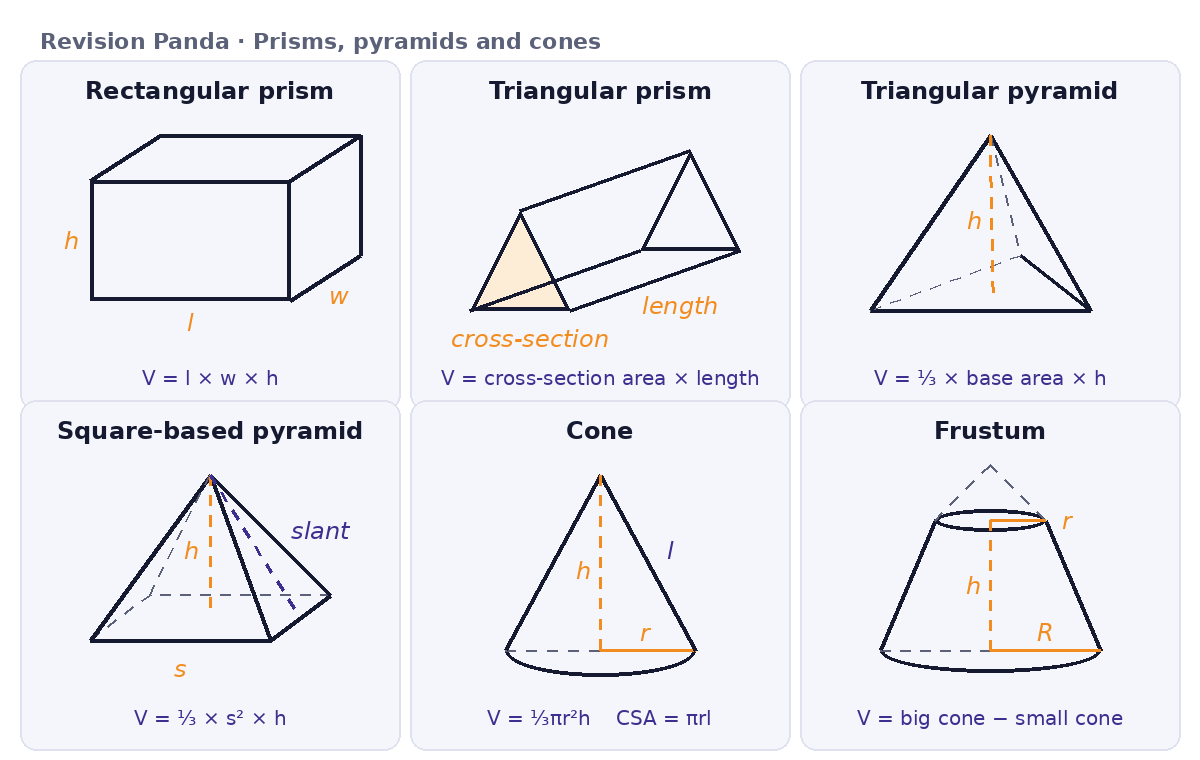
Rectangular prism (cuboid)
| Formula | Worked example: 12 cm × 8 cm × 5 cm | |
|---|---|---|
| Volume | V = l × w × h | 12 × 8 × 5 = 480 cm³ |
| Surface area | SA = 2(lw + lh + wh) | 2(96 + 60 + 40) = 392 cm² |
Where it comes from: the base is a rectangle of area l × w, and the prism rule multiplies that by the height. A cuboid has three pairs of identical faces, which is why the surface area formula doubles the sum of the three different face areas. An open-topped box has one fewer face: subtract lw once.
Triangular prism
| Formula | Worked example: right-angled triangle with sides 3, 4 and 5 cm; length 10 cm | |
|---|---|---|
| Cross-section area | ½ × base × height of the triangle | ½ × 3 × 4 = 6 cm² |
| Volume | Cross-section area × length | 6 × 10 = 60 cm³ |
| Surface area | 2 triangles + 3 rectangles | 2 × 6 + (3 + 4 + 5) × 10 = 12 + 120 = 132 cm² |
The three rectangles all have the prism’s length, so their total area is the triangle’s perimeter times the length. That shortcut works for any prism.
Cylinder
| Formula | Worked example: r = 5 cm, h = 8 cm | |
|---|---|---|
| Volume | V = πr²h | π × 25 × 8 = 200π ≈ 628 cm³ |
| Curved surface area | 2πrh | 2π × 5 × 8 = 80π |
| Total surface area | 2πr² + 2πrh | 50π + 80π = 130π ≈ 408 cm² |
Where it comes from: a cylinder is a prism with a circular cross-section, so the volume is πr² times the height. Unroll the curved surface and it becomes a rectangle whose width is the circumference 2πr and whose height is h. That gives 2πrh.
Pyramids
A pyramid has a polygon base and triangular faces that meet at the apex. Its volume is always one third of base area times perpendicular height, whatever shape the base is.
Why one third? A cube can be cut into three identical square-based pyramids, each with its apex at the same corner of the cube. Each pyramid has the cube’s base and height, so each holds exactly one third of the cube’s volume. The same one-third relationship holds for every pyramid and cone.
Triangular pyramid (tetrahedron)
| Formula | Worked example: base a right-angled triangle with legs 6 cm and 8 cm; height 10 cm | |
|---|---|---|
| Base area | ½ × base × height of the triangle | ½ × 6 × 8 = 24 cm² |
| Volume | V = ⅓ × base area × h | ⅓ × 24 × 10 = 80 cm³ |
| Surface area | Base + three triangular faces | Find each face’s area separately; they are usually different |
Take care with two different ‘heights’: the height of the base triangle (used for the base area) and the perpendicular height of the pyramid (from the apex straight down to the base).
Square-based pyramid
| Formula | Worked example: base 10 cm × 10 cm; perpendicular height 12 cm | |
|---|---|---|
| Volume | ⅓ × s² × h | ⅓ × 100 × 12 = 400 cm³ |
| Slant height of each face | √(h² + (s/2)²) | √(144 + 25) = 13 cm |
| Surface area | s² + 4 × ½ × s × slant height | 100 + 4 × ½ × 10 × 13 = 100 + 260 = 360 cm² |
The slant height comes from a right-angled triangle inside the pyramid: the perpendicular height, half the base side, and the slant height as the hypotenuse. This Pythagoras step appears in many exam questions.
Cones
| Formula | Worked example: r = 5 cm, h = 12 cm | |
|---|---|---|
| Slant height | l = √(r² + h²) | √(25 + 144) = 13 cm |
| Volume | V = ⅓πr²h | ⅓ × π × 25 × 12 = 100π ≈ 314 cm³ |
| Curved surface area | πrl | π × 5 × 13 = 65π ≈ 204 cm² |
| Total surface area | πrl + πr² | 65π + 25π = 90π ≈ 283 cm² |
Where it comes from: a cone is a pyramid with a circular base, so its volume is one third of the cylinder with the same base and height. Unrolled, its curved surface is a sector of a circle of radius l. The sector’s arc length equals the base circumference 2πr, which leads to the curved area πrl.
Volume uses h
The perpendicular height, from the apex straight down to the centre of the base.
Curved area uses l
The slant height, measured along the sloping side. Pythagoras links the two: l² = r² + h².
Frustums
A frustum is what is left when the top of a cone or pyramid is cut off parallel to the base, like a lampshade or a bucket. The safest method is to subtract the small cone from the large cone.
Method: big cone minus small cone
A cone of radius 6 cm and height 12 cm has its top 6 cm removed. The removed cone is similar, with radius 3 cm and height 6 cm.
Volume = ⅓π(6²)(12) − ⅓π(3²)(6) = 144π − 18π = 126π ≈ 396 cm³
Direct formula
V = ⅓πh(R² + Rr + r²), where R and r are the two radii and h is the frustum’s height.
Check: ⅓π × 6 × (36 + 18 + 9) = 126π, the same answer.
Most school exams expect the subtraction method, often with similar triangles to find the missing height. Learn that first; the direct formula is a useful check.
Spheres and hemispheres
| Formula | Worked example: r = 4 cm | |
|---|---|---|
| Sphere volume | ⅔πr³ | ⅔ × π × 64 = 256π/3 ≈ 268 cm³ |
| Sphere surface area | 4πr² | 4 × π × 16 = 64π ≈ 201 cm² |
| Hemisphere volume | ⅔πr³ | Half the sphere: 128π/3 ≈ 134 cm³ |
| Hemisphere total surface area | 3πr² | Curved 2πr² + flat circle πr² = 48π ≈ 151 cm² |
The sphere formulas are usually given on exam formula sheets because they are hard to derive at school level. A useful check: the surface area of a sphere is exactly four times the area of a circle with the same radius.
Composite solids and working backwards
Composite: a pencil shape
A cylinder of radius 2 cm and length 10 cm with a cone of the same radius and height 3 cm on the end.
Volume = π × 4 × 10 + ⅓ × π × 4 × 3 = 40π + 4π = 44π ≈ 138 cm³.
For surface area, include only the outside faces: the join between the cylinder and the cone is hidden.
Backwards: find the radius
A cylinder has volume 500 cm³ and height 10 cm. Find its radius.
500 = πr² × 10, so r² = 500 ÷ (10π) ≈ 15.9, and r ≈ 3.99 cm.
The same idea works for a sphere: if V = 1000 cm³, then r³ = 3000 ÷ (4π), so r ≈ 6.20 cm.
Questions that give the volume and ask for a length are common in higher-tier and Extended papers. Substitute what you know, rearrange to isolate the unknown, and only round at the very end.
Similar solids
If two solids are similar with a length scale factor k, their surface areas are in the ratio k² and their volumes in the ratio k³. Doubling every length of a cone multiplies its surface area by 4 and its volume by 8. This is how frustum questions often find the missing small cone.
All the formulas in one table
| Solid | Volume | Surface area |
|---|---|---|
| Cube (edge a) | a³ | 6a² |
| Cuboid | lwh | 2(lw + lh + wh) |
| Any prism | Cross-section area × length | 2 × cross-section + perimeter × length |
| Cylinder | πr²h | 2πr² + 2πrh |
| Any pyramid | ⅓ × base area × h | Base + all triangular faces |
| Cone | ⅓πr²h | πrl + πr² |
| Frustum of a cone | ⅓πh(R² + Rr + r²) | Curved area of big cone − small cone, plus both circles |
| Sphere | ⅔πr³ | 4πr² |
| Hemisphere | ⅔πr³ | 3πr² (including the flat face) |
For area, perimeter and circle formulas, see our complete geometry formulas reference. If terms such as edge, vertex, face or perpendicular are unfamiliar, start with our geometry basics guide.
Which formulas will you be given?
Cambridge IGCSE Mathematics (0580)
Every paper from 2025 includes a formula list with the volumes of a prism, pyramid, cylinder, cone and sphere, and the curved surface areas of a cylinder and cone, plus the surface area of a sphere. Formulas for rectangles and other basic shapes are not given.
GCSE Mathematics (England)
Ofqual has confirmed that formulae sheets will be provided in GCSE maths exams for the lifetime of the current specifications. Check your board’s sheet for exactly which volume and surface area formulas it includes.
Even when a formula is given, you still need to know which one a question needs and how to find the inputs, especially perpendicular and slant heights. Practise until choosing the formula is automatic.
Finding surface area with a net
Sketch the net
Unfold the solid into flat shapes. A cuboid gives six rectangles; a square-based pyramid gives one square and four triangles; a cylinder gives two circles and a rectangle.
Label every length
Write the dimensions on each face. Use Pythagoras to find any missing slant heights first.
Find each face’s area
Work out each face separately, grouping identical faces to save time.
Add, and check what is included
Add all the faces. Then check the question: an open box, a pipe or a cone without its base all leave something out.
Units, conversions and capacity
Converting units
- 1 cm² = 100 mm²; 1 m² = 10 000 cm²
- 1 cm³ = 1000 mm³; 1 m³ = 1 000 000 cm³
- Square the length factor for area; cube it for volume
Capacity
- 1 litre = 1000 cm³
- 1 ml = 1 cm³
- 1 m³ = 1000 litres
Example: a cylindrical tank has radius 10 cm and height 30 cm. Volume = π × 100 × 30 = 3000π ≈ 9425 cm³, which is about 9.42 litres. Convert every length to the same unit before you start, never halfway through.
Common mistakes
Slant height in the volume
Using l instead of h in ⅓πr²h or a pyramid formula gives a volume that is too large.
Forgetting the ⅓
Leaving out the one third for a pyramid or cone gives three times the right volume.
Missing or extra faces
Count faces from a net. Open containers, pipes and cones without bases change what is included.
Diameter for radius
Many questions give a diameter. Halve it before squaring or cubing.
Mixed units
A radius in cm with a height in m gives a meaningless result. Convert first.
Wrong units in the answer
Volume needs cubic units and surface area square units. A missing ³ or ² can cost a mark.
Practice questions
Try each one, then check against the answer. Give answers to 3 significant figures where they are not exact.
| Question | Answer |
|---|---|
| 1. A box measures 12 cm by 8 cm by 5 cm. Find its volume and surface area. | 480 cm³; 392 cm² |
| 2. A cone has radius 4 cm and perpendicular height 3 cm. Find its volume and total surface area. | l = 5 cm; volume 16π ≈ 50.3 cm³; surface area 36π ≈ 113 cm² |
| 3. A pyramid has a square base of side 9 cm and perpendicular height 8 cm. Find its volume. | ⅓ × 81 × 8 = 216 cm³ |
| 4. How many litres does a cylinder of radius 10 cm and height 30 cm hold? | 3000π cm³ ≈ 9.42 litres |
For exam-style practice, use official past papers for your syllabus. Our IGCSE maths formulas guide shows which of these formulas are printed on the Cambridge IGCSE formula sheet and which you must learn.
The short version
Prisms and cylinders: volume = cross-section area × length. Pyramids and cones: volume = ⅓ × base area × perpendicular height. Cones also need the slant height l = √(r² + h²) for the curved surface πrl. For surface area, sketch the net and add every face. Use the perpendicular height for volume, check radius versus diameter, keep units consistent, and remember 1 litre = 1000 cm³.
Choose your curriculumSources and method. The formulas on this page are standard mathematical results taught in Cambridge IGCSE, GCSE and US high school geometry. The ‘three pyramids make a cube’ explanation and the cone net derivation are standard teaching arguments. All worked examples and practice answers were calculated and checked by Revision Panda; rounded answers are to 3 significant figures. Last checked November 2026.