Cambridge Lower Secondary and Checkpoint: A Guide for Parents and Students
Cambridge Lower Secondary covers ages 11 to 14 in Stages 7 to 9. Checkpoint is an optional, Cambridge-marked diagnostic test at the end of Stage 9 that shows strengths and gaps before IGCSE.
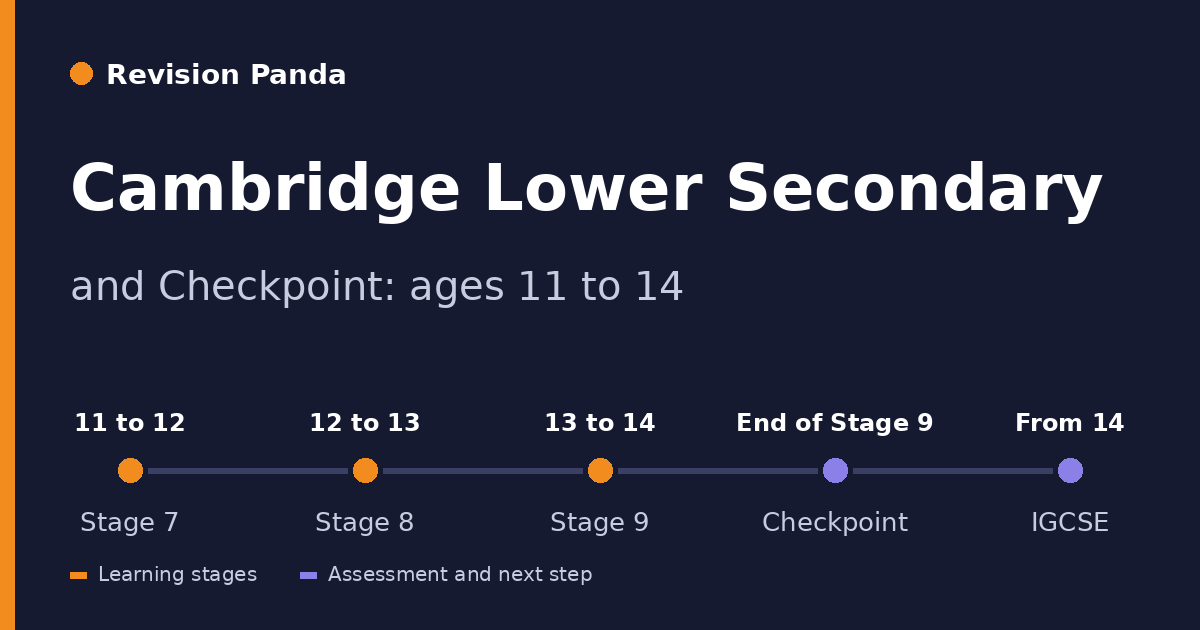
Cambridge Lower Secondary is the stage for students aged about 11 to 14, between Primary and IGCSE. It builds on Primary learning in English, mathematics and science, adds more challenge, and prepares students for the exam courses that follow. At the end, schools can enter students for Cambridge Checkpoint, a set of diagnostic tests that shows strengths and gaps before IGCSE begins.
- 11 to 14typical age range
- 3stages: Stage 7, Stage 8 and Stage 9
- 4Checkpoint test subjects, including English and maths
- 0 to 50Checkpoint score scale since May 2023
The three stages of Lower Secondary
Lower Secondary is organised as Stages 7, 8 and 9. Each stage roughly matches a school year, so you can use the table to see where your child sits in the UK or US system. School start dates differ, so treat it as a guide.
| Cambridge stage | Typical age | UK year | US grade |
|---|---|---|---|
| Stage 7 | 11 to 12 | Year 7 | Grade 6 |
| Stage 8 | 12 to 13 | Year 8 | Grade 7 |
| Stage 9 | 13 to 14 | Year 9 | Grade 8 |
What students study
English, mathematics and science sit at the heart of the programme, because every later stage depends on them. Schools can add other subjects around that core, so the exact mix depends on the school.
The core
English (and English as a second language), mathematics and science. These are the subjects Cambridge’s Checkpoint tests cover.
Skills subjects
Cambridge Global Perspectives, computing and digital literacy build research, thinking and technology skills.
Creative and active
Art and design, music and physical education keep the timetable balanced.
Cambridge’s curriculum frameworks cover about ten or more subjects. Your school chooses which ones to teach.
Stage by stage: what each subject builds
Cambridge’s frameworks organise each core subject into strands, and students revisit each strand at a higher level every year. This is a plain-language picture of the typical progression. It is not Cambridge’s exact list of learning objectives, and schools sequence topics differently.
Mathematics
| Strand | Stage 7 | Stage 8 | Stage 9 |
|---|---|---|---|
| Number | Fractions, decimals and percentages; ordering and rounding | Ratio, proportion, powers and roots | Multi-step and real-life problems with mixed number types |
| Algebra | Letters for unknowns, simple expressions and sequences | Forming and solving linear equations; substituting into formulas | Rearranging formulas, graphs of linear functions, harder equations |
| Geometry and measure | Angles, shapes and units | Area, perimeter, volume and basic transformations | Reasoning with shape and angle properties in harder problems |
| Statistics and probability | Collecting data, charts and averages | Comparing data sets and simple probability | Interpreting graphs, combined events and drawing conclusions |
Science
| Strand | Stage 7 | Stage 8 | Stage 9 |
|---|---|---|---|
| Biology | Living things, cells and classification | Body systems, nutrition and ecosystems | Inheritance, variation and human impact on the environment |
| Chemistry | States of matter, mixtures and separation | Atoms, elements and the periodic table | Patterns in chemical reactions and reactivity |
| Physics | Forces, energy and measurement | Light, sound and electricity | Motion, energy transfers and Earth in space |
| Thinking and working scientifically | Planning fair tests and recording results | Presenting data in tables and graphs | Evaluating evidence and explaining conclusions |
English
| Strand | Stage 7 | Stage 8 | Stage 9 |
|---|---|---|---|
| Reading | Understanding texts and finding evidence | Comparing texts and exploring writers’ choices | Analysing language, structure and viewpoint |
| Writing | Clear sentences and paragraphs for different purposes | Planning, structuring and developing ideas | Controlled, persuasive and descriptive writing for an audience |
| Speaking and listening | Talking in groups and listening carefully | Presenting ideas and responding to others | Discussing and arguing a viewpoint with evidence |
Check your school’s own curriculum outline for the exact topics and order. The IGCSE maths and science pages in this series show where these strands lead next.
The Lower Secondary journey
- Stage 7Settle inMove from Primary to a broader, faster programme
- Stage 8Build depthStrengthen algebra, writing and scientific skills
- Stage 9PrepareClose gaps and think about IGCSE subjects
- End of Stage 9CheckpointOptional diagnostic tests marked by Cambridge
- Age 14Start IGCSEMove into Upper Secondary exam courses
LearningAssessment and transition
What Cambridge Checkpoint is
Checkpoint is a diagnostic assessment. It is not a pass-or-fail exam and it does not give a qualification. Its job is to show a student’s strengths and weaknesses at the end of Stage 9, so teachers and families can make better decisions about IGCSE.
Who takes it
Schools choose whether to enter students. It is optional, and schools that do not use it can still follow the Lower Secondary programme.
Which subjects
English, English as a second language, mathematics and science. Cambridge Global Perspectives is assessed through a research report marked in school.
Who marks it
Cambridge marks the English, maths and science tests, so the results are comparable across schools. The score is reported with feedback on strengths and weaknesses.
When
At the end of Stage 9, in a series set by Cambridge. Ask your school which series it uses.
Checkpoint, Progression Tests and school exams
Families sometimes mix up the different assessments a school might use. This comparison separates the two Cambridge options.
Checkpoint
- Taken at the end of Stage 9
- Marked by Cambridge
- Gives an external benchmark
- Optional, and school-entered
Progression Tests
- Available for Stages 7, 8 and 9
- Marked by the school’s teachers
- Used to track progress during the year
- Given when the teacher feels the class is ready
Checkpoint test formats
Checkpoint is sat in a Cambridge exam series, with each subject taken on a different day. Cambridge publishes a timetable for each series, for example October 2026 and March 2027, and your school decides which series it enters. English, mathematics and science each have two papers.
| Subject | Papers and length | Calculator | What it tests |
|---|---|---|---|
| English (0861) | Paper 1 non-fiction and Paper 2 fiction, 1 hour 10 minutes each | Not applicable | Reading and writing, with a text to respond to in each paper |
| Mathematics (0862) | Paper 1 and Paper 2, 1 hour each | Not allowed in Paper 1. Allowed in Paper 2. | Number, algebra, geometry and measure, statistics and probability |
| Science (0893) | Paper 1 and Paper 2, 45 minutes each | Follow the instructions on each paper | Biology, chemistry, physics and scientific enquiry skills |
| English as a Second Language (0876) | Three components of 45, 35 and 40 minutes | Not applicable | Language skills for students learning English |
| Global Perspectives (1129) | A research report, not a timed paper | Not applicable | Research, analysis and reflection, marked in school and moderated by Cambridge |
Syllabus codes and times were checked against Cambridge’s published Checkpoint timetables. The calculator rules for maths come from school exam schedules and sample tests, so confirm the rule printed on your child’s paper.
Calculator rules and materials
Maths Paper 1
- No calculator
- Tests mental and written methods
- Show every step of working
Maths Paper 2
- Calculator allowed
- Bring geometrical instruments
- Tracing paper is typically optional
Papers usually say “You must answer on the question paper” and ask for a black or dark blue pen. Always check the instructions printed on the front of each paper, and make sure your child’s calculator is allowed and has working batteries.
Pacing: how long per mark?
If each paper is worth about 50 marks, you can estimate a time budget. This is a useful rule of thumb for practice, not an official figure.
| Subject | Time per paper | Rough time per mark | Pacing tip |
|---|---|---|---|
| English | 1 hour 10 minutes | About 1.4 minutes | Plan reading and writing time before you start |
| Mathematics | 1 hour | About 1.2 minutes | Move on from a stuck question and return to it |
| Science | 45 minutes | About 0.9 minutes | Short answers, so keep moving steadily |
Test-day and practice checklist
- Ask your school for official past or sample Checkpoint papers and practise one paper per subject under timed conditions.
- Practise maths Paper 1 without a calculator, especially fractions, percentages and multiplication.
- Read the instructions and the number of marks for each question before answering.
- Show working in maths and science, because method can earn marks even when the answer is wrong.
- Check calculator, pens, instruments and exam centre arrangements the day before.
How to read Checkpoint results
Since the May 2023 series, Cambridge reports Checkpoint results on a scale from 0 to 50, grouped into performance bands. This replaced the older 0.0 to 6.0 scale, so you may still see the old format in older material. Whichever format you see, these habits help.
- Treat it as a diagnostic. It shows where to focus, not whether your child has passed or failed.
- Compare subjects, not children. Look at which subject is strongest and weakest for your child, and which topics inside each need work.
- Use the feedback report. The detailed feedback matters more than the single number.
- Match results to IGCSE choices. A strong maths result supports Extended tier plans, while a weaker one suggests extra practice first.
- Remember it is a snapshot. Cambridge gives guidance on expected IGCSE standards, but a student’s later grade also depends on effort and teaching.
The bands, from lowest to highest
- 0Unclassified
- 1 to 10Basic
- 11 to 20Aspiring
- 21 to 30Good
- 31 to 40High
- 41 to 50Outstanding
Scores are standardised, not percentages, so a score of 30 does not mean 60%. The same score reflects the same level of performance in every subject.
A worked example
Here is a made-up report for a student called Maya at the end of Stage 9. The numbers are illustrative only.
| Subject | Score | Band | What it suggests |
|---|---|---|---|
| English | 38 | High | A strong base for IGCSE English |
| Mathematics | 24 | Good | Secure, but the lowest of her three scores |
| Science | 33 | High | Strong, and comfortable going into IGCSE sciences |
- Find each band. Maya sits in High for English and Science and Good for Mathematics.
- Compare across subjects. Because the same score means the same performance level in every subject, maths is clearly her weakest area.
- Open the strand feedback. The detailed report might show her number work is secure but algebra is weaker. That points to what to practise.
- Make a plan. She could take the Extended maths route with extra algebra practice over the summer, and her teacher confirms the tier closer to IGCSE.
Cambridge’s guidance links the Good and Outstanding bands to expected IGCSE standards, roughly grade C or 4 and grade A or 7. Treat that as indicative, not a prediction.
Are they ready for IGCSE? A readiness check
These are the foundations that make the first term of IGCSE much smoother. They are general guidance, not an official Cambridge list.
| Subject | Foundations to have by the end of Stage 9 | Common gap |
|---|---|---|
| Mathematics | Confident fractions, percentages, ratio and basic algebra, including rearranging simple equations | Showing no working, or weak algebra |
| English | Clear paragraph writing, reading for meaning and using evidence | Writing without a plan |
| Science | Core ideas in biology, chemistry and physics, and reading graphs and tables | Weak data and experiment skills |
Joining from another system
Many families join Cambridge Lower Secondary after a move, or switch schools part-way through. Ages line up well with the UK and US systems, so the main work is checking gaps, not starting again.
From the UK
Years 7 to 9 match Stages 7 to 9 by age. Compare maths and science topics, because the order can differ.
From the US
Grades 6 to 8 match Stages 7 to 9. Check algebra readiness and how sciences were taught, since US schools often integrate them.
From IB or a national curriculum
Match by age first, then ask the school for a placement check in maths and English.
| If your child joins… | What to do first | Watch for |
|---|---|---|
| At Stage 7 | Share previous reports and confirm core skills | Little to catch up on, but check English writing |
| At Stage 8 | Ask for a maths and English check against the Stage 7 content | Gaps in algebra and ratio |
| At Stage 9 | Ask which subjects and tiers lead to IGCSE, and whether Checkpoint entry is possible | Little time to close big gaps |
| Straight into IGCSE | Check the maths and science level and the exam series deadlines | Missing Lower Secondary foundations |
- Gather recent school reports, test results and a curriculum outline from the previous school.
- Ask the new school which stage your child joins and whether they sit Checkpoint.
- Request a short diagnostic in maths and English in the first month.
- Agree a catch-up plan with a clear review date.
Choosing IGCSE subjects
Stage 9 is the time to think about subject choices, because they shape A Level and university options later. Check which IGCSEs your school offers and which tiers you are likely to be entered for. Our Cambridge IGCSE guide explains subjects, tiers and grading, and the Cambridge Pathway guide shows how the stages connect.
How parents can help
Keep a steady routine
Short, regular study sessions beat long weekend sessions, especially in maths.
Fix gaps early
If a topic keeps going wrong, go back to the earlier skill behind it before moving on.
Ask good questions
Ask your child to explain a topic in their own words. It shows quickly what is secure.
Questions to ask your school
- Do you enter students for Cambridge Checkpoint, and in which subjects?
- Which series do you use, and when do we receive results?
- How are Checkpoint results used when choosing IGCSE subjects and tiers?
- How do you support students who arrive part-way through Lower Secondary?
The short version
Cambridge Lower Secondary covers ages 11 to 14 in three stages. Checkpoint is an optional, Cambridge-marked diagnostic at the end of Stage 9, now reported on a 0 to 50 scale. Use it to find gaps in English, maths and science, then plan IGCSE subjects with confidence.
Choose your curriculumSources and method: Stages, ages, subjects and Checkpoint arrangements were checked against Cambridge International’s Lower Secondary guide for parents its Checkpoint subjects help page and its performance band table. Checkpoint codes, papers and durations come from Cambridge’s March 2027 and October 2026 timetables. The stage-by-stage tables are a general summary, and the worked example uses made-up scores. The 0 to 50 scale change dates from the May 2023 series. We review this page at least once a year.