Cambridge AS & A Level Mathematics (9709): Syllabus and Revision Guide
Cambridge AS & A Level Mathematics 9709 has six papers: Pure Mathematics 1, 2 and 3, Mechanics, and Probability & Statistics 1 and 2. AS is Papers 1 and 2, 1 and 4, or 1 and 5. A Level is Papers 1 and 3 plus either 4 and 5, or 5 and 6.
9709 is Cambridge International's AS & A Level maths syllabus for ages 16 to 19, built from Pure Mathematics, Mechanics and Probability & Statistics papers.
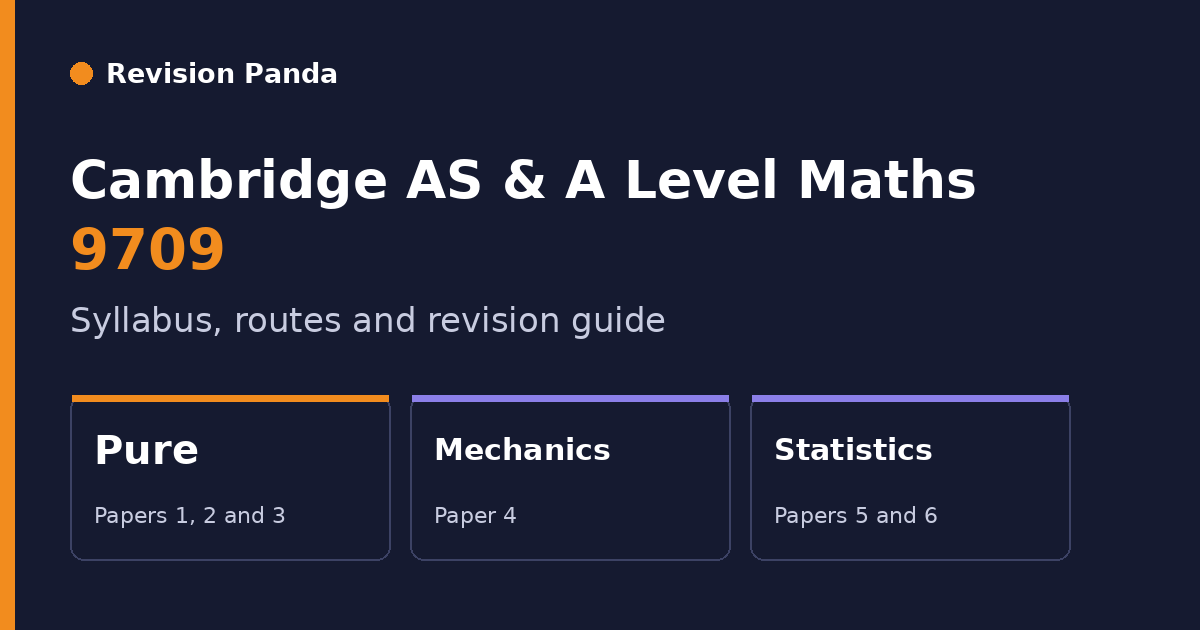
Cambridge International AS & A Level Mathematics (9709) is Cambridge’s main maths qualification for ages 16 to 19. It is built from six papers in three strands: Pure Mathematics, Mechanics, and Probability & Statistics. Which papers you sit depends on whether you are taking AS or the full A Level, and which applied route you choose. This guide covers the syllabus for exams in 2026 and 2027: the papers, every permitted route, the topic map, the formula booklet and calculator rules, and how to revise.
- 9709syllabus code
- 6papers, of which you sit 2 for AS or 4 for A Level
- 3strands: Pure, Mechanics, Statistics
- A*–EA Level grades (AS: a to e)
How 9709 is built: six papers, three strands
9709 is modular: each paper covers one area of maths, and you combine papers to make an AS Level or a full A Level. Pure Mathematics is compulsory in every route and makes up the largest share.
| Paper | Title | Time | Marks | Weighting | Used for |
|---|---|---|---|---|---|
| Paper 1 | Pure Mathematics 1 | 1 h 50 min | 75 | 60% of AS; 30% of A Level | Compulsory for AS and A Level |
| Paper 2 | Pure Mathematics 2 | 1 h 15 min | 50 | 40% of AS | AS only |
| Paper 3 | Pure Mathematics 3 | 1 h 50 min | 75 | 30% of A Level | Compulsory for A Level |
| Paper 4 | Mechanics | 1 h 15 min | 50 | 40% of AS; 20% of A Level | AS or A Level |
| Paper 5 | Probability & Statistics 1 | 1 h 15 min | 50 | 40% of AS; 20% of A Level | AS or A Level; compulsory for A Level |
| Paper 6 | Probability & Statistics 2 | 1 h 15 min | 50 | 20% of A Level | A Level only |
Exams run in the June and November series, with a March series in India. AS Level is graded a to e and the full A Level A* to E.
Every permitted route
This is the part of 9709 that confuses most students and parents. Only certain combinations of papers are allowed.
AS Level (2 papers)
- Papers 1 and 2: Pure only. This AS cannot count towards an A Level later.
- Papers 1 and 4: Pure with Mechanics
- Papers 1 and 5: Pure with Statistics
A Level (4 papers)
- Everyone takes Papers 1 and 3 (Pure)
- Plus Papers 4 and 5 (Mechanics and Statistics 1), or
- Plus Papers 5 and 6 (Statistics 1 and 2)
- Papers 4 and 6 cannot be combined, because Paper 6 builds on Paper 5
Staged or linear?
Students can take the A Level in one go at the end of the course (linear) or in two stages, taking AS papers in the first year and the rest in the second (staged). The staged combinations allowed are:
| Year 1 (AS) | Year 2 (to complete A Level) | Applied content overall |
|---|---|---|
| Papers 1 and 4 | Papers 3 and 5 | Mechanics and Statistics 1 |
| Papers 1 and 5 | Papers 3 and 4 | Statistics 1 and Mechanics |
| Papers 1 and 5 | Papers 3 and 6 | Statistics 1 and 2 |
A linear A Level means all four papers in one series: Papers 1, 3, 4 and 5, or Papers 1, 3, 5 and 6. Note that Paper 2 and Paper 3 cannot be taken in the same series. Paper 2’s content is largely a subset of Paper 3’s, so Paper 2 is only for students finishing at AS. For more on how staged and linear routes work across Cambridge subjects, see our AS & A Level guide.
The most common route mistake: taking Papers 1 and 2 as an AS and then deciding to continue to A Level. Because a Pure-only AS cannot be carried forward, the student must start again with a permitted combination. If A Level is at all likely, choose Papers 1 and 4 or Papers 1 and 5 for AS.
Mechanics or Statistics: which applied route?
At A Level, the choice is between Mechanics plus Statistics 1, or two Statistics papers. Schools often decide this for the whole class, but where there is a choice, think about what you will study next.
Mechanics and Statistics (Papers 4 and 5)
Suits students heading for physics, engineering or other physical sciences, where forces, motion and energy come up again. It also gives a broader mix of applied maths.
Statistics 1 and 2 (Papers 5 and 6)
Suits students heading for economics, biology, psychology, business or social sciences, where hypothesis testing and distributions are directly useful.
This is general guidance, not a university requirement. Check the course pages of the universities you are considering, and ask your school which routes it actually teaches.
The 9709 topic map
| Paper | Topics |
|---|---|
| Pure Mathematics 1 | Quadratics; functions; coordinate geometry; circular measure; trigonometry; series; differentiation; integration |
| Pure Mathematics 2 (AS only) | Algebra; logarithmic and exponential functions; trigonometry; differentiation; integration; numerical solution of equations |
| Pure Mathematics 3 | Algebra; logarithmic and exponential functions; trigonometry; differentiation; integration; numerical solution of equations; vectors; differential equations; complex numbers |
| Mechanics | Forces and equilibrium; kinematics of motion in a straight line; momentum; Newton’s laws of motion; energy, work and power |
| Probability & Statistics 1 | Representation of data; permutations and combinations; probability; discrete random variables; the normal distribution |
| Probability & Statistics 2 | The Poisson distribution; linear combinations of random variables; continuous random variables; sampling and estimation; hypothesis tests |
Pure Mathematics 3 is the heaviest paper and introduces the most new ideas: vectors, differential equations and complex numbers appear nowhere else in 9709. Pure 1 underpins everything, so weaknesses there, such as in algebra, functions or basic calculus, tend to cost marks across all the other papers.
Formulas, calculators and accuracy
These rules apply to every 9709 paper and are worth learning before your first mock.
- Formula booklet: you are given the list of formulae and statistical tables, known as MF19. It is shared with Further Mathematics (9231), so some sections do not apply to 9709.
- Not everything is in MF19: many standard results you must still know, so check the booklet early and learn what is missing. Our A Level maths formulas guide sorts formulas into those given and those to memorise.
- Calculators: a scientific calculator is required. Graphical calculators and calculators with symbolic algebra or calculus functions are not allowed.
- Show working: answers from a calculator with no supporting working may earn no marks.
- Accuracy: give non-exact answers to 3 significant figures, or angles in degrees to 1 decimal place, unless the question says otherwise. Do not round until the final answer.
- Mechanics: take g as 10 m s−2, not 9.8 or 9.81.
- Equipment: you need a ruler; a protractor and compasses are not required.
The jump from IGCSE to A Level maths
Most students find the step from Cambridge IGCSE Mathematics to 9709 bigger than they expect, mainly in Pure Mathematics. Questions are longer, there is less guidance on method, and algebra must be quick and accurate because almost every question depends on it.
Algebra fluency
Factorising, completing the square, manipulating indices and fractions, and solving simultaneous equations need to be automatic before Pure 1 gets going.
Functions and graphs
Composite and inverse functions, transformations of graphs and sketching curves are built on in Pure 1 and Pure 3.
Trigonometry
Exact values, the sine and cosine rules, and confidence with angles beyond 90° prepare you for circular measure and trigonometric equations.
If you took Extended IGCSE maths, you have met most of the foundations. Our Cambridge IGCSE Mathematics 0580 guide lists the topics; revising the Extended algebra, functions and trigonometry the summer before A Level is one of the most effective things a student can do.
Worked example: a typical Pure 1 question
The question
Find the coordinates of the stationary point on the curve y = x² − 6x + 5 and determine its nature.
The method
dy/dx = 2x − 6. At a stationary point dy/dx = 0, so x = 3. Then y = 9 − 18 + 5 = −4. d²y/dx² = 2, which is positive, so (3, −4) is a minimum.
Each line earns marks: the derivative, setting it to zero, finding both coordinates and justifying the nature. Writing only ‘(3, −4) minimum’ risks losing most of them.
Worked examples: Mechanics and Statistics
Mechanics: Newton’s second law
Question: A car of mass 1200 kg has a driving force of 3000 N and experiences a resistance of 600 N. Find its acceleration.
Resultant force = 3000 − 600 = 2400 N. Using F = ma: 2400 = 1200a, so a = 2 m s−2.
Draw a force diagram first: most Mechanics errors come from a missing or wrongly directed force.
Statistics: the normal distribution
Question: X ~ N(50, 4²). Find P(X < 56).
Standardise: z = (56 − 50) ÷ 4 = 1.5. From the tables, Φ(1.5) = 0.9332, so P(X < 56) = 0.933 to 3 significant figures.
Sketch the curve and shade the region every time: it shows instantly whether the answer should be above or below 0.5.
A typical two-year plan
Schools sequence 9709 differently, but a staged A Level often looks like this. Linear students cover the same content but sit every paper at the end of the second year.
| Stage | What usually happens |
|---|---|
| Year 1, autumn | Pure 1 begins: quadratics, functions, coordinate geometry. The applied paper (Mechanics or Statistics 1) often starts alongside. |
| Year 1, spring | Pure 1 calculus and trigonometry; the applied paper continues. First full mock papers. |
| Year 1, summer | Staged students sit AS papers (for example Papers 1 and 5) in the June series. |
| Year 2, autumn and spring | Pure 3 and the second applied paper. Pure 3’s new topics (vectors, complex numbers, differential equations) need the most time. |
| Year 2, summer | Final papers in the June series; linear students sit all four papers in this series. |
The advantage of staging is a first result after one year and a lighter final exam season. The disadvantage is less time to mature before the AS papers, and AS results are fixed into the final grade. Ask your school how it plans the course and whether resits are possible.
How to revise for 9709
Know your route
Confirm which papers you are sitting and in which series. Revise only the papers on your route, and download the matching past papers.
Secure Pure 1 first
Pure 1 is in every route and supports everything else. Work through it topic by topic until you can answer exam questions on each without notes.
Learn the booklet, then what is missing
Get to know MF19 so you can find a formula in seconds, then make a list of results you must memorise.
Practise by topic, then mixed
Use past-paper questions sorted by topic until your accuracy is high, then switch to full mixed papers, where recognising which method a question needs is part of the challenge.
Mark with the mark scheme
Mark every paper with the official mark scheme, noting method (M), accuracy (A) and independent (B) marks. Our guide to using A Level past papers and mark schemes explains how.
Keep an error log
Record every mistake by paper, topic and type: algebra slip, wrong method, accuracy, misreading. Revise from the log in the final weeks.
Pacing yourself in the exam
| Paper | Time | Marks | Time per mark |
|---|---|---|---|
| Pure 1 or Pure 3 | 110 minutes | 75 | About 1 minute 28 seconds |
| Pure 2, Mechanics, Statistics 1 or Statistics 2 | 75 minutes | 50 | 1½ minutes |
9709 gives more time per mark than IGCSE because questions need more steps. Use that time for clear working, which protects method marks, and for checking that you answered exactly what was asked.
A good habit for the longer Pure papers: do a first pass answering everything you can do confidently, then return to the harder parts. Later questions are often worth more marks and are not always harder than earlier ones.
Common mistakes in A Level maths
Calculator mode
Circular measure and calculus questions often use radians. Using degrees mode, or the reverse, gives wrong answers that look plausible.
Missing the +c
Indefinite integrals need a constant of integration. Forgetting it, or not finding it when a point on the curve is given, is a classic lost mark.
‘Show that’ shortcuts
When the answer is given, every step must be written. Jumping to the given result earns little, however obvious it seems.
Wrong value of g
Mechanics in 9709 uses g = 10 m s−2. Using 9.8 changes the final answer and can lose the accuracy mark.
Incomplete hypothesis tests
A test needs hypotheses, the test statistic or probability, a comparison with the significance level, and a conclusion in context.
Premature rounding
Rounding intermediate values pushes final answers outside the accepted range. Keep full values until the end.
What comes next, and syllabus changes
A Level Mathematics is a common requirement for university courses in maths, physics, engineering, computer science and economics, and many of those courses expect a high grade. Students who enjoy the subject may also take Cambridge International AS & A Level Further Mathematics (9231), which shares the MF19 formula booklet.
This guide covers the syllabus for exams in 2026 and 2027. Cambridge has published a new 9709 syllabus for exams in 2028, 2029 and 2030. Students who will sit exams in 2028 or later should check the new syllabus for any changes to papers or content.
Questions to ask your maths teacher
- Which route am I on: which papers, and in which series?
- Is the school teaching Mechanics and Statistics, or Statistics 1 and 2?
- Am I taking the A Level staged or linear?
- If I take AS only, which papers will I sit, and can it count towards an A Level later?
- Which syllabus year applies to my exams?
- Which results in MF19 should I memorise, and which will I always be given?
- What grade do the universities I am considering ask for?
The short version
Cambridge AS & A Level Mathematics 9709 has six papers across Pure, Mechanics and Statistics. AS is two papers (1 and 2, 1 and 4, or 1 and 5); A Level is Papers 1 and 3 plus either 4 and 5 or 5 and 6. A Pure-only AS (Papers 1 and 2) cannot count towards an A Level. You get the MF19 formula booklet, need a scientific calculator, give answers to 3 significant figures and use g = 10 in Mechanics. Secure Pure 1 first, then practise by topic and with full past papers marked against the official mark scheme.
Choose your curriculumSources and method. Papers, durations, marks, weightings, permitted AS, A Level, staged and linear routes, the Paper 2 and Paper 3 rule, topics, MF19, calculator rules, accuracy, the value of g, equipment, grades and series: Cambridge International AS & A Level Mathematics 9709 syllabus for 2026 and 2027 (Cambridge International). 2028–2030 syllabus: Cambridge International. Route advice, the IGCSE-to-A Level bridge, revision steps, pacing and common mistakes are Revision Panda’s editorial guidance. We do not reproduce past papers or mark schemes; use the official versions. Last checked November 2026.