Cambridge IGCSE Chemistry (0620): Syllabus, Topics and Revision Guide
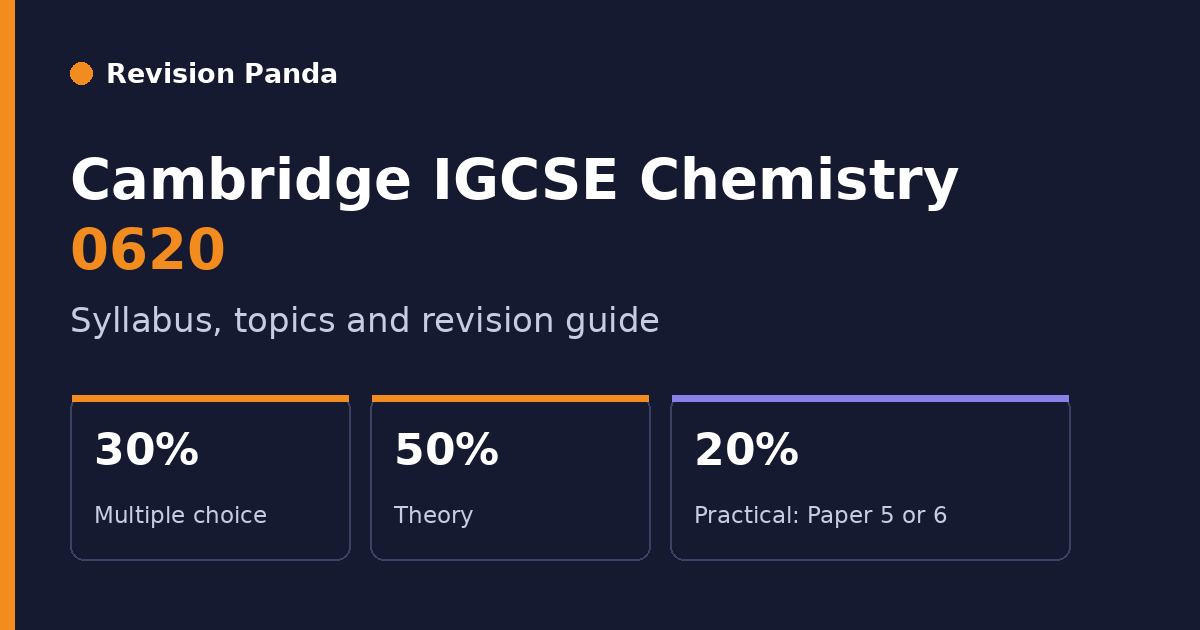
Cambridge IGCSE Chemistry 0620 is assessed by three papers: multiple choice (30%), theory (50%) and practical skills (20%), which is either Paper 5 (lab practical) or Paper 6 (written alternative). Core students sit Papers 1 and 3 for grades C to G. Extended students sit Papers 2 and 4 and can achieve A* to G.
0620 is Cambridge International's single-subject IGCSE chemistry syllabus for ages 14 to 16, graded A* to G and covering twelve topics from states of matter to chemical analysis.
Cambridge IGCSE Chemistry (0620) is Cambridge’s full single-subject chemistry qualification for ages 14 to 16. This guide covers the current syllabus for exams in 2026, 2027 and 2028: the papers you sit, Core versus Extended, the practical paper options, all twelve topic areas, the calculations and equations that run through the course, and a revision plan built around how the exam is marked.
- 0620syllabus code, graded A* to G
- 3papers per student, including one practical paper
- 12topic areas, from states of matter to chemical analysis
- 20%of the grade comes from practical skills
What is Cambridge IGCSE Chemistry 0620?
0620 is a single-science IGCSE: one grade in chemistry alone. Exams run in the June and November series, with an extra March series for schools in India. There is no coursework; everything is assessed by exams.
The syllabus on this page is for exams in 2026, 2027 and 2028. Cambridge says it has no significant changes that affect teaching compared with the previous version, and textbooks endorsed for exams from 2023 are still suitable. A syllabus for 2029 exams has also been published.
Schools choose between several Cambridge chemistry and science syllabuses, and some cannot be taken together. A student cannot sit 0620 in the same series as Cambridge IGCSE (9–1) Chemistry 0971, Physical Science 0652, Combined Science 0653, Co-ordinated Sciences 0654 or 0973, or the O Level chemistry and combined science syllabuses. 0971 has the same content but is graded 9 to 1 instead of A* to G. For how IGCSE fits into the wider Cambridge pathway, see our Cambridge IGCSE guide.
Paper structure: what you actually sit
Every 0620 student sits three papers: multiple choice, theory and a practical-skills paper. The first two depend on your tier. The practical paper is Paper 5 or Paper 6, whichever your school enters you for.
| Paper | Tier | Type | Time | Marks | Weighting |
|---|---|---|---|---|---|
| Paper 1 | Core | Multiple choice: 40 four-option questions | 45 min | 40 | 30% |
| Paper 2 | Extended | Multiple choice: 40 four-option questions | 45 min | 40 | 30% |
| Paper 3 | Core | Theory: short-answer and structured questions | 1 h 15 min | 80 | 50% |
| Paper 4 | Extended | Theory: short-answer and structured questions | 1 h 15 min | 80 | 50% |
| Paper 5 | Both | Practical test in a laboratory | 1 h 15 min | 40 | 20% |
| Paper 6 | Both | Alternative to practical (written) | 1 h | 40 | 20% |
Core route
- Paper 1 (multiple choice) + Paper 3 (theory)
- Plus Paper 5 or Paper 6
- Grades available: C to G
- Covers the Core content only
Extended route
- Paper 2 (multiple choice) + Paper 4 (theory)
- Plus Paper 5 or Paper 6
- Grades available: A* to G
- Covers the Core content plus the Supplement content
As in IGCSE physics, the Extended route can award the full range of grades. Calculators may be used in all parts of the exam.
What the papers are testing
| Assessment objective | What it means | Share of the qualification | Where it is tested |
|---|---|---|---|
| AO1 | Knowledge with understanding: facts, definitions, names, formulae and equations | 50% | 63% of Papers 1 to 4 |
| AO2 | Handling information and solving problems: calculations, data, unfamiliar reactions | 30% | 37% of Papers 1 to 4 |
| AO3 | Experimental skills and investigations | 20% | All of Paper 5 or Paper 6 |
Chemistry rewards accurate recall more than most subjects: half the qualification is knowledge, much of it precise wording, formulae and observations. That makes regular self-testing the single most useful revision habit.
Paper 5 or Paper 6: the practical options
Paper 5: Practical Test
- 1 hour 15 minutes, 40 marks
- You carry out experiments in a laboratory under exam conditions
- Typical tasks include titrations, rates experiments and tests to identify ions or gases
- Needs the school to run supervised practical sessions
Paper 6: Alternative to Practical
- 1 hour, 40 marks
- A written paper: no experiments in the exam room
- Tests the same skills using described experiments, diagrams and data
- Common for private candidates and schools without exam lab facilities
Both papers are worth 20% and test the same experimental skills. For both, Cambridge provides notes for use in qualitative analysis: the tests for anions, cations and gases, and flame tests. You do not need to memorise the results tables for the practical paper, but you do need to know how to carry out each test, describe what you observe and draw a conclusion. On the theory papers, tests for ions and gases can still be asked from memory, so learn them anyway.
Our IGCSE science practical skills guide covers Paper 5 and Paper 6 in detail, including results tables, graphs and evaluating methods.
The 0620 topic map
The syllabus has twelve topic areas. Extended (Supplement) content sits inside each topic, so Extended students go further under the same headings.
| Topic | Sub-topics |
|---|---|
| 1. States of matter | Solids, liquids and gases; diffusion |
| 2. Atoms, elements and compounds | Elements, compounds and mixtures; atomic structure and the Periodic Table; isotopes; ions and ionic bonds; simple molecules and covalent bonds; giant covalent structures; metallic bonding |
| 3. Stoichiometry | Formulae; relative masses of atoms and molecules; the mole and the Avogadro constant |
| 4. Electrochemistry | Electrolysis; hydrogen–oxygen fuel cells |
| 5. Chemical energetics | Exothermic and endothermic reactions |
| 6. Chemical reactions | Physical and chemical changes; rate of reaction; reversible reactions and equilibrium; redox |
| 7. Acids, bases and salts | Characteristic properties of acids and bases; oxides; preparation of salts |
| 8. The Periodic Table | Arrangement of elements; Group I; Group VII; transition elements; noble gases |
| 9. Metals | Properties of metals; uses of metals; alloys and their properties; reactivity series; corrosion of metals; extraction of metals |
| 10. Chemistry of the environment | Water; fertilisers; air quality and climate |
| 11. Organic chemistry | Formulae, functional groups and terminology; naming organic compounds; fuels; alkanes; alkenes; alcohols; carboxylic acids; polymers |
| 12. Experimental techniques and chemical analysis | Experimental design; acid–base titrations; chromatography; separation and purification; identification of ions and gases |
Use the official syllabus as your checklist: it marks every Supplement learning outcome individually. Tick each outcome off once you can answer an exam question on it without notes.
Where Extended students find the step up: mole calculations in topic 3 underpin questions across the whole paper, from electrolysis to titrations. Ionic and half-equations in electrochemistry and redox, and equilibrium in topic 6, are other common sticking points. Start these early and keep practising them.
The Periodic Table and the reference pages you will use
A copy of the Periodic Table appears in the syllabus and on the exam papers. Knowing where to find it is not the same as knowing how to use it. Questions expect you to:
- Read relative atomic masses and atomic numbers correctly, and use them in calculations.
- Work out the number of protons, neutrons and electrons, and the electronic configuration, from an element’s position.
- Explain trends down Group I and Group VII, and the properties of transition elements and noble gases.
- Predict the properties of an unfamiliar element from its group, a favourite AO2 question style.
Our periodic table guide for IGCSE, GCSE and A Level explains groups, periods and trends with exam-style examples. The data printed with the papers also states that one mole of any gas occupies 24 dm³ at room temperature and pressure.
Bonding and structure (topic 2) is about how atoms join, not the three-dimensional shapes of molecules. IGCSE does not require VSEPR theory, but students heading to AS & A Level Chemistry will meet it early. Our molecular geometry and VSEPR guide is a useful bridge once IGCSE bonding is secure.
Calculations and equations: the core skills
Chemistry has fewer equations to memorise than physics, but a few skills come up in almost every paper.
Balanced equations
Write word and symbol equations, balance them and add state symbols, (s), (l), (g) and (aq). Extended students also write ionic equations and half-equations.
Moles
Amount in moles = mass ÷ molar mass. Extended students use this for reacting masses, limiting reactants, percentage yield and purity, and empirical and molecular formulae.
Gases and solutions
Gas volume = moles × 24 dm³ at room temperature and pressure. Concentration in mol/dm³ = moles ÷ volume in dm³. Both are used in titration calculations.
A reliable calculation method: write the balanced equation, convert what you know into moles, use the mole ratio from the equation, then convert back into the quantity asked for. Show each step, because method marks are available even when the final number is wrong.
Two worked examples
Reacting masses and gas volume
Question: 10.0 g of calcium carbonate is heated until it fully decomposes. What mass of carbon dioxide forms, and what volume does it occupy at room temperature and pressure?
1. Equation: CaCO3(s) → CaO(s) + CO2(g)
2. Mr of CaCO3 = 40 + 12 + (3 × 16) = 100, so moles = 10.0 ÷ 100 = 0.100 mol
3. Mole ratio 1 : 1, so 0.100 mol of CO2
4. Mass = 0.100 × 44 = 4.40 g
5. Volume = 0.100 × 24 = 2.40 dm³
Titration
Question: 25.0 cm³ of sodium hydroxide solution is exactly neutralised by 20.0 cm³ of 0.100 mol/dm³ hydrochloric acid. What is the concentration of the sodium hydroxide?
1. Equation: NaOH(aq) + HCl(aq) → NaCl(aq) + H2O(l)
2. Moles of HCl = 0.100 × (20.0 ÷ 1000) = 0.00200 mol
3. Mole ratio 1 : 1, so 0.00200 mol of NaOH
4. Concentration = 0.00200 ÷ (25.0 ÷ 1000) = 0.0800 mol/dm³
Both follow the same four moves: equation, moles, ratio, convert. Notice the cm³ to dm³ conversion in the titration: it is the step most often missed.
Organic naming and formulae
Organic chemistry (topic 11) has its own language. Learn the functional groups (alkene, alcohol, carboxylic acid), the general formulae of each homologous series and the naming rules for the chain lengths in the syllabus. Practise drawing displayed formulae showing every bond, because diagrams with a missing hydrogen or a carbon with five bonds lose marks.
Command words: what the question wants
The syllabus lists the command words used in 0620 questions. The most frequent are below, with what each asks for.
| Command word | What to do |
|---|---|
| State / Give / Identify | A short, direct answer: a name, formula, value or observation |
| Define | The precise meaning of a term, such as ‘isotopes’ or ‘oxidation’ |
| Describe | Say what happens or what you would see; no reasons required |
| Explain | Give reasons in terms of particles, bonding or structure |
| Calculate / Determine | Work out a value, showing working and units |
| Deduce / Predict | Reach a conclusion or forecast from data or known patterns |
| Suggest | Apply ideas to an unfamiliar situation; several answers may be accepted |
| Compare / Contrast | Similarities and/or differences, referring to both things in each point |
| Evaluate / Discuss | Weigh up evidence or arguments and reach a judgement |
In chemistry the difference between describe and explain often comes down to observations versus particles. ‘Describe what you would see’ wants bubbles, a colour change or a precipitate. ‘Explain’ wants the reason, for example more frequent collisions between particles.
How to revise for 0620
Audit the syllabus
Rate every learning outcome for your tier red, amber or green. Green means you can answer an exam question on it without notes.
Self-test the facts
Use flashcards for definitions, formulae of common ions, tests for ions and gases, colours, and organic reactions. Test from memory rather than re-reading notes.
Practise calculations every week
Do a short set of mole, gas volume and concentration questions each week from early in the course. Calculations get faster only with repetition.
Write equations by hand
Practise balancing equations with state symbols and, for Extended, ionic and half-equations. Write them out; recognising a balanced equation is not the same as producing one.
Revise practical skills separately
Work through apparatus, titration technique, results tables, graphs and evaluating methods. These are worth 20% of the grade on their own.
Move to timed past papers
Sit full papers for your tier under timed conditions, mark them with the official mark scheme and keep an error log. Our guide to using IGCSE past papers explains how.
Pacing yourself in the exam
| Paper | Time | Marks | Roughly |
|---|---|---|---|
| Paper 1 or 2 (multiple choice) | 45 minutes | 40 | About 1 minute per question |
| Paper 3 or 4 (theory) | 75 minutes | 80 | Just under 1 minute per mark |
| Paper 5 (practical test) | 75 minutes | 40 | Nearly 2 minutes per mark, including time for experiments |
| Paper 6 (alternative to practical) | 60 minutes | 40 | 1½ minutes per mark |
Common mistakes in IGCSE chemistry
Mixing up particles
Atoms, molecules and ions are not interchangeable. ‘Sodium chloride molecules’ or ‘chlorine ions’ instead of chloride ions can cost the mark.
Unbalanced equations
Correct formulae with wrong balancing, or missing state symbols when they are asked for, lose marks on otherwise good answers.
Observation versus conclusion
‘Hydrogen is produced’ is a conclusion; ‘bubbles form’ or ‘a lighted splint pops’ is an observation. Give the one the question asks for.
Unit slips
Volumes in titrations are often given in cm³ but concentration uses dm³. Divide by 1000 before calculating.
Vague rate answers
Rate explanations need particles: more frequent collisions, or more particles with energy above the activation energy, not just ‘they react faster’.
Careless displayed formulae
Every carbon needs four bonds and every bond must be shown. Check each atom before moving on.
Series, grades and what comes next
0620 exams run in June, with results in August, and in November, with results in January; the March series is available in India. Grades run from A* to G, with U for ungraded, and grade thresholds are published after every series. A strong Extended grade is the usual preparation for Cambridge International AS & A Level Chemistry. Our AS & A Level guide explains that stage.
Questions to ask your chemistry teacher
- Am I entered for 0620 or 0971, and for Core or Extended?
- Will I take Paper 5 (practical test) or Paper 6 (alternative to practical)?
- Which tests for ions and gases should I know from memory for the theory papers?
- Which topics have not yet been taught?
- What were my weakest topics and skills in my last mock?
- Can I have the official mark schemes and examiner reports for practice papers?
- What grade do I need to study chemistry at AS & A Level?
The short version
Cambridge IGCSE Chemistry 0620 is assessed by three papers: multiple choice (30%), theory (50%) and practical skills (20%). Core students sit Papers 1 and 3 for grades C to G; Extended students sit Papers 2 and 4 and can achieve A* to G. Everyone also takes Paper 5 (lab practical) or Paper 6 (written alternative). The syllabus covers twelve topics, with mole calculations, balanced equations and precise chemical language running through all of them. Self-test the facts, practise calculations weekly and revise practical skills as seriously as theory.
Choose your curriculumSources and method. Papers, durations, marks, weightings, routes, grades available, assessment objectives, topics and sub-topics, command words, calculator rule, qualitative analysis notes, molar gas volume, combination restrictions and series: Cambridge IGCSE Chemistry 0620 syllabus for 2026, 2027 and 2028 (Cambridge International). 2029 syllabus: Cambridge International. Revision steps, pacing, common mistakes and the plain-English command-word guide are Revision Panda’s editorial guidance. We do not reproduce past papers or mark schemes; use the official versions. Last checked November 2026.