Cambridge IGCSE Biology (0610): Syllabus, Topics and Revision Guide
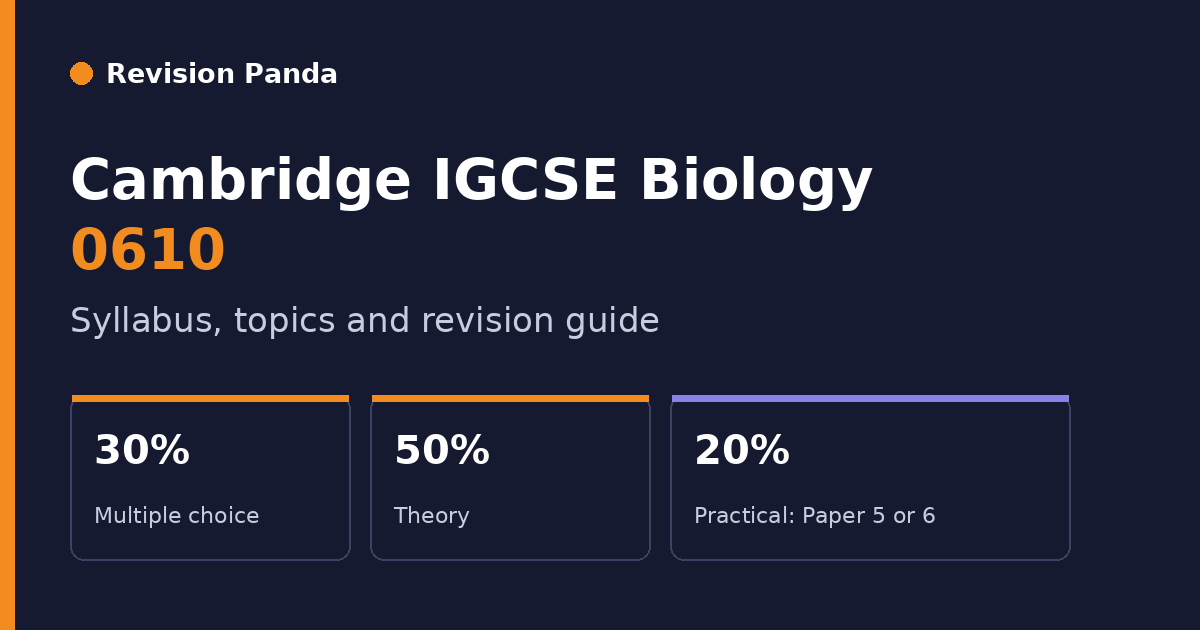
Cambridge IGCSE Biology 0610 is assessed by three papers: multiple choice (30%), theory (50%) and practical skills (20%), which is either Paper 5 (lab practical) or Paper 6 (written alternative). Core students sit Papers 1 and 3 for grades C to G. Extended students sit Papers 2 and 4 and can achieve A* to G.
0610 is Cambridge International's single-subject IGCSE biology syllabus for ages 14 to 16, graded A* to G and covering 21 topics from cells to biotechnology.
- Three papers: multiple choice 30%, theory 50%, practical skills 20%
- Core grades: C to G; Extended grades: A* to G
- Cambridge advises Extended content for students aiming at A* to C
- 21 topics, from classification to biotechnology and genetic modification
- Calculators may be used in all parts of the exam
- Current syllabus covers exams in 2026, 2027 and 2028
Cambridge IGCSE Biology (0610) is Cambridge’s full single-subject biology qualification for ages 14 to 16. This guide covers the current syllabus for exams in 2026, 2027 and 2028: the papers you sit, Core versus Extended, the practical paper options, all 21 topics, the practical skills and maths biology needs, and a revision plan built around how the exam is marked.
- 0610syllabus code, graded A* to G
- 3papers per student, including one practical paper
- 21topics, from cells to biotechnology
- 20%of the grade comes from practical skills
What is Cambridge IGCSE Biology 0610?
0610 is a single-science IGCSE: one grade in biology alone. Exams run in the June and November series, plus a March series for schools in India. There is no coursework; everything is assessed by exams.
The syllabus on this page is for exams in 2026, 2027 and 2028. Cambridge notes no significant changes that affect teaching compared with the previous version, and textbooks endorsed for exams from 2023 are still suitable. A syllabus for 2029 exams has also been published, again with no significant changes affecting teaching.
Most schools teach 0610 as a two-year course from around age 14, often alongside IGCSE chemistry and physics. Because the content is broad, the students who do best usually revise each topic soon after it is taught, rather than meeting most of the syllabus again for the first time in the final months.
Cambridge also offers 0970, the same biology content graded 9 to 1, as well as combined and co-ordinated science syllabuses that cover less biology. If biology at AS & A Level is a possibility, 0610 Extended is the most direct preparation. For how IGCSE fits into the wider Cambridge pathway, see our Cambridge IGCSE guide.
Paper structure: what you actually sit
Every 0610 student sits three papers: multiple choice, theory and a practical-skills paper. Biology uses the same structure as Cambridge IGCSE physics and chemistry.
| Paper | Tier | Type | Time | Marks | Weighting |
|---|---|---|---|---|---|
| Paper 1 | Core | Multiple choice: 40 four-option questions | 45 min | 40 | 30% |
| Paper 2 | Extended | Multiple choice: 40 four-option questions | 45 min | 40 | 30% |
| Paper 3 | Core | Theory: short-answer and structured questions | 1 h 15 min | 80 | 50% |
| Paper 4 | Extended | Theory: short-answer and structured questions | 1 h 15 min | 80 | 50% |
| Paper 5 | Both | Practical test in a laboratory | 1 h 15 min | 40 | 20% |
| Paper 6 | Both | Alternative to practical (written) | 1 h | 40 | 20% |
Core route
- Paper 1 (multiple choice) + Paper 3 (theory)
- Plus Paper 5 or Paper 6
- Grades available: C to G
- Covers the Core content only
Extended route
- Paper 2 (multiple choice) + Paper 4 (theory)
- Plus Paper 5 or Paper 6
- Grades available: A* to G
- Covers the Core content plus the Supplement content
Cambridge advises that students aiming for grades A* to C should be taught the Extended content. Calculators may be used in all parts of the exam.
What the papers are testing
| Assessment objective | What it means | Share of the qualification | Where it is tested |
|---|---|---|---|
| AO1 | Knowledge with understanding: terms, structures, processes | 50% | 63% of Papers 1 to 4 |
| AO2 | Handling information and solving problems: data, graphs, unfamiliar examples | 30% | 37% of Papers 1 to 4 |
| AO3 | Experimental skills and investigations | 20% | All of Paper 5 or Paper 6 |
Biology has more content to learn than physics or chemistry, so the knowledge half of the marks rewards steady, early revision. The AO2 third usually puts familiar biology into an unfamiliar context, such as a graph from an experiment you have never seen or an organism not named in the syllabus. That is why practising with data, not just notes, matters.
Paper 5 or Paper 6: the practical options
Paper 5: Practical Test
- 1 hour 15 minutes, 40 marks
- You carry out experiments in a laboratory under exam conditions
- Tasks can include food tests, measuring and drawing specimens, and investigations into enzymes or osmosis
- Needs the school to run supervised practical sessions
Paper 6: Alternative to Practical
- 1 hour, 40 marks
- A written paper: no experiments in the exam room
- Tests the same skills using described experiments, photographs and data
- Common for private candidates and schools without exam lab facilities
Both papers are worth 20% and test the same skills. The syllabus lists the practical contexts students should be familiar with, including food tests, diffusion, osmosis, enzyme activity, photosynthesis, transpiration, respiration, tropic responses and germination. Students should also be able to observe, measure and draw biological specimens and calculate magnification or actual size.
The food tests to know
| Testing for | Reagent | Positive result |
|---|---|---|
| Starch | Iodine solution | Orange-brown turns blue-black |
| Reducing sugars | Benedict’s solution, heated in a water bath | Blue turns green, yellow, orange or brick-red depending on the amount of sugar |
| Protein | Biuret reagent | Blue turns purple (violet) |
| Fats and oils | Ethanol, then water (emulsion test) | A cloudy white emulsion forms |
| Vitamin C | DCPIP | Blue DCPIP is decolourised |
Learn the method as well as the result: for example, Benedict’s test needs heating, and a safety point such as using a water bath rather than a naked flame with ethanol often earns a mark. Our IGCSE science practical skills guide covers both practical papers, including biological drawings, results tables and graphs.
The 0610 topic map
The syllabus has 21 topics. Extended (Supplement) content sits within the topics, so Extended students go further under the same headings.
| Topic | Sub-topics |
|---|---|
| 1. Characteristics and classification of living organisms | Characteristics of living organisms; concept and uses of classification systems; features of organisms |
| 2. Organisation of the organism | Cell structure; size of specimens |
| 3. Movement into and out of cells | Diffusion; osmosis; active transport |
| 4. Biological molecules | Biological molecules |
| 5. Enzymes | Enzymes |
| 6. Plant nutrition | Photosynthesis; leaf structure |
| 7. Human nutrition | Diet; digestive system; physical digestion; chemical digestion; absorption |
| 8. Transport in plants | Xylem and phloem; water uptake; transpiration; translocation |
| 9. Transport in animals | Circulatory systems; heart; blood vessels; blood |
| 10. Diseases and immunity | Diseases and immunity |
| 11. Gas exchange in humans | Gas exchange in humans |
| 12. Respiration | Respiration; aerobic respiration; anaerobic respiration |
| 13. Excretion in humans | Excretion in humans |
| 14. Coordination and response | Coordination and response; sense organs; hormones; homeostasis; tropic responses |
| 15. Drugs | Drugs |
| 16. Reproduction | Asexual reproduction; sexual reproduction; in plants; in humans; sex hormones in humans; sexually transmitted infections |
| 17. Inheritance | Chromosomes, genes and proteins; mitosis; meiosis; monohybrid inheritance |
| 18. Variation and selection | Variation; adaptive features; selection |
| 19. Organisms and their environment | Energy flow; food chains and food webs; nutrient cycles; populations |
| 20. Human influences on ecosystems | Food supply; habitat destruction; pollution; conservation |
| 21. Biotechnology and genetic modification | Biotechnology; genetic modification |
Revise in connected blocks, not 21 separate pieces. Topics 3, 6, 8 and 11 all rely on diffusion and surface area. Topics 7, 9, 12 and 13 follow substances around the human body. Topics 17 and 18 (inheritance and selection) work best revised together. Linking topics this way helps with the longer AO2 questions, which often cross topic boundaries.
Use the official syllabus as your checklist; every Supplement learning outcome is marked. Inheritance (genetic diagrams and ratios), homeostasis and the heart are common places where Extended students need extra practice.
The maths in biology
Biology is not maths-heavy, but the syllabus lists mathematical requirements and they turn up on every paper: percentages, standard form, significant figures, direct and inverse proportion, unit conversions, surface area to volume ratio, gradients and intercepts of graphs, and means and ranges.
Worked example: magnification
The formula
Magnification = image size ÷ actual size. Rearranged: actual size = image size ÷ magnification. Both sizes must be in the same unit before you divide.
The question
A drawing of a cell is 45 mm long. The real cell is 0.15 mm long. Magnification = 45 ÷ 0.15 = ×300. Magnification has no units, but the × sign is usual.
Unit conversion is where most marks are lost. Remember 1 mm = 1000 µm, so a cell of 0.15 mm is 150 µm. Mixing millimetres and micrometres gives an answer a thousand times too big or too small.
Graphs and data
Expect to plot line graphs and bar charts, read values and describe trends. When describing a graph, quote data with units (‘rose from 12 to 30 arbitrary units between 20 °C and 40 °C’), describe the overall pattern, and mention any change in pattern, such as a peak or a plateau. Only explain the trend if the question asks you to.
Two model answers
Longer questions in biology are marked point by point. These examples show how a strong answer builds marks one idea at a time.
An ‘explain’ question
Question (4 marks): Explain what happens to a plant cell placed in a concentrated salt solution.
• The solution outside the cell is more concentrated than the cell sap.
• Water leaves the cell by osmosis,
• through the partially permeable cell membrane,
• so the vacuole shrinks and the cytoplasm pulls away from the cell wall: the cell becomes plasmolysed.
Each bullet is one creditable idea. An answer that says only ‘the cell shrinks because of osmosis’ covers about one of them.
A genetic cross
Question: In pea plants, tall (T) is dominant to short (t). Two heterozygous tall plants are crossed. Predict the ratio of offspring.
• Parental genotypes: Tt × Tt
• Gametes: T and t from each parent
• Offspring genotypes: TT, Tt, Tt, tt
• Phenotypes: 3 tall : 1 short
Show every stage, including the gametes. Marks are given for each step of the genetic diagram, not just the final ratio.
Command words: what the question wants
| Command word | What to do |
|---|---|
| State / Give / Identify | A short, direct answer: a name, term, value or structure |
| Define | The precise meaning of a term, such as ‘osmosis’ or ‘gene’ |
| Describe | Say what happens or what a structure is like; for graphs, give the trend with data |
| Explain | Give reasons, using biological ideas to say why or how |
| Calculate | Work out a value, showing working and units |
| Suggest | Apply biology to an unfamiliar situation; more than one answer may be accepted |
| Compare | Similarities and/or differences, referring to both things in each point |
| Predict / Deduce | Reach a conclusion or forecast from the information given |
Check the full list and Cambridge’s own definitions in the syllabus. The most common slip in biology is answering ‘describe’ with an explanation, or ‘compare’ with two separate descriptions that never link the two things.
How to revise for 0610
Audit the syllabus
Rate every learning outcome for your tier red, amber or green. Biology has a lot of content, so this shows where your time is best spent.
Build a keyword bank
Biology marks often depend on exact terms: ‘partially permeable membrane’, ‘active site’, ‘concentration gradient’. Make flashcards for key terms and definitions and test yourself daily.
Draw and label from memory
Practise the key diagrams without looking: cells, the heart, the leaf, the digestive system, the eye and the kidney. Then check against your notes.
Practise data questions
Work through past-paper questions with graphs and tables. Describe trends with data, then practise explaining them.
Revise practical skills separately
Learn food tests, how to control variables, how to draw specimens and how to calculate magnification. These skills are worth 20% of the grade.
Move to timed past papers
Sit full papers for your tier, mark them with the official mark scheme and keep an error log. Our guide to using IGCSE past papers explains how.
Pacing yourself in the exam
| Paper | Time | Marks | Roughly |
|---|---|---|---|
| Paper 1 or 2 (multiple choice) | 45 minutes | 40 | About 1 minute per question |
| Paper 3 or 4 (theory) | 75 minutes | 80 | Just under 1 minute per mark |
| Paper 5 (practical test) | 75 minutes | 40 | Nearly 2 minutes per mark, including experiment time |
| Paper 6 (alternative to practical) | 60 minutes | 40 | 1½ minutes per mark |
On the theory paper, use the number of marks as a guide to the number of points needed. A 3-mark ‘explain’ question usually needs three distinct, relevant ideas.
Common mistakes in IGCSE biology
Everyday words instead of biology
‘The plant makes food’ or ‘the enzyme dies’ lose marks. Use ‘photosynthesis produces glucose’ and ‘the enzyme is denatured’.
Describing when asked to explain
Saying a rate rises then falls describes the graph. An explanation gives the reason, such as more collisions as temperature rises, then denaturation above the optimum.
Data without units
Quoting numbers from a graph or table without units, or without the matching values on the other axis, often loses the data mark.
Mixing up similar terms
Mitosis and meiosis, gene and allele, ventilation and respiration, transpiration and translocation are all commonly confused. Make a comparison table for each pair.
Poor biological drawings
Drawings need clear, continuous lines, no shading, sensible size and label lines that touch the structure. Sketchy or shaded drawings lose marks.
Unit errors in magnification
Converting between mm and µm is the step most often missed in magnification and actual-size calculations.
Series, grades and what comes next
0610 exams run in June, with results in August, and in November, with results in January; the March series is available in India. Grades run from A* to G, with U for ungraded, and grade thresholds are published after every series. A strong Extended grade is the usual preparation for Cambridge International AS & A Level Biology, often alongside chemistry. Our AS & A Level guide explains that stage.
Questions to ask your biology teacher
- Am I entered for 0610 or 0970, and for Core or Extended?
- Will I take Paper 5 (practical test) or Paper 6 (alternative to practical)?
- Which practical investigations have we done, and which should I review from the syllabus list?
- Which topics have not yet been taught?
- What were my weakest topics and skills in my last mock?
- Can I have the official mark schemes and examiner reports for practice papers?
- What grade do I need to study biology at AS & A Level?
The short version
Cambridge IGCSE Biology 0610 is assessed by three papers: multiple choice (30%), theory (50%) and practical skills (20%). Core students sit Papers 1 and 3 for grades C to G; Extended students sit Papers 2 and 4 and can achieve A* to G. Everyone also takes Paper 5 (lab practical) or Paper 6 (written alternative). There are 21 topics, so start early, learn exact biological terms, practise diagrams and data questions, and revise practical skills such as food tests and magnification as seriously as the theory.
Choose your curriculumSources and method. Papers, durations, marks, weightings, routes, grades available, the advice on Extended for A* to C, assessment objectives, topics and sub-topics, calculator rule, mathematical requirements, practical contexts, apparatus and reagents: Cambridge IGCSE Biology 0610 syllabus for 2026, 2027 and 2028 (Cambridge International). 2029 syllabus: Cambridge International. Food test results are standard practice and should be checked against your teacher’s method. Command-word guidance, revision steps, pacing and common mistakes are Revision Panda’s editorial guidance. We do not reproduce past papers or mark schemes; use the official versions. Last checked November 2026.